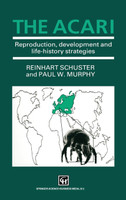
One Life-history Strategies.- 1 The life strategies of mites.- 2 Life-history evolution of spider mites.- 3 Life-cycle strategies in unpredictably varying environments: genetic adaptations in a colonizing mite.- 4 The evolutionary transformation of osmotic regulation in the life cycle of freshwater mites (Hydrachnidia).- 5 Development and life-history strategies in mussel mites (Hydrachnellae: Unionicolidae).- Two Reproduction.- 6 Spermatology in the Acari: systematic and functional implications.- 7 The distribution, mechanisms and evolutionary significance of parthenogenesis in oribatid mites.- 8 Indirect sperm transfer in prostigmatic mites from a phylogenetic viewpoint.- 9 Spermatophore deposition in relation to atmospheric humidity among terrestrial Parasitengonae (Prostigmata).- 10 The role of Adlerocystis sp. in the reproduction of argasid ticks.- 11 A scanning electron-microscopy study of spermatogenesis in Pergamasus barbarus Berl. (Gamasida.- 12 Precise sex-ratio control in the pseudo-arrhenotokous phytoseiid mite, Typhlodromus occidentalis Nesbitt.- 13 Sex ratio, fitness and capacity for population increase in Pyemotes tritici (L.-F. and M.) (Pyemotidae).- 14 Preliminary observations of ovoviviparity in the gallforming mite, Aceria caulobius (Nal.) (Eriophyidea: Eriophyidae).- 15 Laboratory observations on duration of copulation and egg production of three phytoseiid species fed on pollen.- 16 Precopulatory mate guarding in the spider mite, Tetranychus cinnabarinus (Boisd.) (Tetranychidae).- Three Diapause, Development and Trophic Relations.- 17 Physiological aspects of diapause in plant-inhabiting mites.- 18 Repeated induction and termination of diapause in the predacious mite, Amblyseius potentillae (Garman) (Phytoseiidae).- 19 Inheritance of photoperiodic responses controlling diapause in the two-spotted spider mite, Tetranychus urticae Koch.- 20 Some observations on diapause in winter eggs of Panonychus ulmi (Koch) (Tetranychidae).- 21 Reproduction, embryonic and postembryonic development of Trichouropoda obscurasimilis Hirschmann and Zirngiebl-Nicol 1961 (Anactinotrichida: Uropodina).- 22 Resource allocation and utilization contrasts in Hypoaspis aculeifer (Can.) and Alliphis halleri (G. and R. Can.) (Mesostigmata) with emphasis on food source.- 23 The influence of different host plants on the reproductive potential of Tyrophagus putrescentiae (Schrank) and Tyrophagus neiswanderi Johnston and Bruce (Acaridae).- 24 The relationship between house-dust mites and fungi.- 25 How plants maintain body-guards: plant exudate as a food source for phytoseiid mites.- Four Systematic, Morphology, Physiology and Behaviour.- 26 Distribution of characters and phylogenetic age - systematic problems in the higher taxa of the Oribatida.- 27 A new approach to the systematics of the genus Steganacarus (Oribatida).- 28 The morphology of the immature stages of Phthiracaroidea (Oribatida).- 29 A new interpretation of the epimeral theory of Grandjean.- 30 A comparison of the sclerotized parts of the reproductive organs of house-dust mites of the genus Dermatophagoides using scanning electron microscopy.- 31 Reproductive systems in Acaridida - some peculiar features.- 32 A respiratory apparatus in eggs of certain mites.- 33 Fine structure and functions of the mouthparts involved in the feeding mechanisms in Cenopalpus pulcher (Canestrini and Fanzago) (Tetranychoidea: Tenuipalpidae).- 34 The alveolar salivary glands of the active phases of trombiculid mites (Trombiculidae).- 35 Pigmentation in water mites of the genera Limnochares Latr. and Hydrodroma Koch (Hydrachnidia).- 36 Biomass studies of water mites of the genera Limnochares Latr. and Hydrodroma Koch (Hydrachnidia).- 37 The saltatory capacity of an oribatid mite.- 38 Thanatosis or feigning death in mites of the family Scutacaridae.- Five Field Studies and Applied Aspects.- 39 The effects of spider-mite feeding on plant performance in relation to biological control.- 40 Dispersio...
One Life-history Strategies.- 1 The life strategies of mites.- 2 Life-history evolution of spider mites.- 3 Life-cycle strategies in unpredictably varying environments: genetic adaptations in a colonizing mite.- 4 The evolutionary transformation of osmotic regulation in the life cycle of freshwater mites (Hydrachnidia).- 5 Development and life-history strategies in mussel mites (Hydrachnellae: Unionicolidae).- Two Reproduction.- 6 Spermatology in the Acari: systematic and functional implications.- 7 The distribution, mechanisms and evolutionary significance of parthenogenesis in oribatid mites.- 8 Indirect sperm transfer in prostigmatic mites from a phylogenetic viewpoint.- 9 Spermatophore deposition in relation to atmospheric humidity among terrestrial Parasitengonae (Prostigmata).- 10 The role of Adlerocystis sp. in the reproduction of argasid ticks.- 11 A scanning electron-microscopy study of spermatogenesis in Pergamasus barbarus Berl. (Gamasida.- 12 Precise sex-ratio control in the pseudo-arrhenotokous phytoseiid mite, Typhlodromus occidentalis Nesbitt.- 13 Sex ratio, fitness and capacity for population increase in Pyemotes tritici (L.-F. and M.) (Pyemotidae).- 14 Preliminary observations of ovoviviparity in the gallforming mite, Aceria caulobius (Nal.) (Eriophyidea: Eriophyidae).- 15 Laboratory observations on duration of copulation and egg production of three phytoseiid species fed on pollen.- 16 Precopulatory mate guarding in the spider mite, Tetranychus cinnabarinus (Boisd.) (Tetranychidae).- Three Diapause, Development and Trophic Relations.- 17 Physiological aspects of diapause in plant-inhabiting mites.- 18 Repeated induction and termination of diapause in the predacious mite, Amblyseius potentillae (Garman) (Phytoseiidae).- 19 Inheritance of photoperiodic responses controlling diapause in the two-spotted spider mite, Tetranychus urticae Koch.- 20 Some observations on diapause in winter eggs of Panonychus ulmi (Koch) (Tetranychidae).- 21 Reproduction, embryonic and postembryonic development of Trichouropoda obscurasimilis Hirschmann and Zirngiebl-Nicol 1961 (Anactinotrichida: Uropodina).- 22 Resource allocation and utilization contrasts in Hypoaspis aculeifer (Can.) and Alliphis halleri (G. and R. Can.) (Mesostigmata) with emphasis on food source.- 23 The influence of different host plants on the reproductive potential of Tyrophagus putrescentiae (Schrank) and Tyrophagus neiswanderi Johnston and Bruce (Acaridae).- 24 The relationship between house-dust mites and fungi.- 25 How plants maintain body-guards: plant exudate as a food source for phytoseiid mites.- Four Systematic, Morphology, Physiology and Behaviour.- 26 Distribution of characters and phylogenetic age - systematic problems in the higher taxa of the Oribatida.- 27 A new approach to the systematics of the genus Steganacarus (Oribatida).- 28 The morphology of the immature stages of Phthiracaroidea (Oribatida).- 29 A new interpretation of the epimeral theory of Grandjean.- 30 A comparison of the sclerotized parts of the reproductive organs of house-dust mites of the genus Dermatophagoides using scanning electron microscopy.- 31 Reproductive systems in Acaridida - some peculiar features.- 32 A respiratory apparatus in eggs of certain mites.- 33 Fine structure and functions of the mouthparts involved in the feeding mechanisms in Cenopalpus pulcher (Canestrini and Fanzago) (Tetranychoidea: Tenuipalpidae).- 34 The alveolar salivary glands of the active phases of trombiculid mites (Trombiculidae).- 35 Pigmentation in water mites of the genera Limnochares Latr. and Hydrodroma Koch (Hydrachnidia).- 36 Biomass studies of water mites of the genera Limnochares Latr. and Hydrodroma Koch (Hydrachnidia).- 37 The saltatory capacity of an oribatid mite.- 38 Thanatosis or feigning death in mites of the family Scutacaridae.- Five Field Studies and Applied Aspects.- 39 The effects of spider-mite feeding on plant performance in relation to biological control.- 40 Dispersio...
Madame Acarie: Etude Sur La Societe Religieuse Aux Seizieme Et Septieme Siecles (1863) est un livre �����crit par Barbe Acarie. Cette �����tude se concentre sur la soci�����t����� religieuse des XVIe...
Acarology is on the move! The growing interest from evolutionary and molecular biologists and from population and community ecologists in mites and ticks has a strong impetus on the field of...
Ticks of the family Ixodidae, commonly known as hard ticks, occur worldwide and are second only to mosquitoes as vectors of agents pathogenic to humans. Of the 729 currently recognized hard tick...
Mites (Acari) for Pest Control is an extremely comprehensive publication, covering in depth the 34 acarine families that contain mites useful for the control of pest mites and insects, nematodes and...
Discover your next great read at BookLoop, Australiand online bookstore offering a vast selection of titles across various genres and interests. Whether you're curious about what's trending or searching for graphic novels that captivate, thrilling crime and mystery fiction, or exhilarating action and adventure stories, our curated collections have something for every reader. Delve into imaginative fantasy worlds or explore the realms of science fiction that challenge the boundaries of reality. Fans of contemporary narratives will find compelling stories in our contemporary fiction section. Embark on epic journeys with our fantasy and science fiction titles,
Shop Trending Books and New Releases
Explore our new releases for the most recent additions in romance books, fantasy books, graphic novels, crime and mystery books, science fiction books as well as biographies, cookbooks, self help books, tarot cards, fortunetelling and much more. With titles covering current trends, booktok and bookstagram recommendations, and emerging authors, BookLoop remains your go-to local australian bookstore for buying books online across all book genres.
Shop Best Books By Collection
Stay updated with the literary world by browsing our trending books, featuring the latest bestsellers and critically acclaimed works. Explore titles from popular brands like Minecraft, Pokemon, Star Wars, Bluey, Lonely Planet, ABIA award winners, Peppa Pig, and our specialised collection of ADHD books. At BookLoop, we are committed to providing a diverse and enriching reading experience for all.
Sign In
your cart
Your cart is empty
Menu
Search
PRE-SALES
If you have any questions before making a purchase chat with our online operators to get more information.