
Trending Bestseller

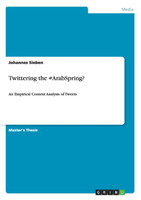
Twittering the #ArabSpring?

An Empirical Content Analysis of Tweets

No reviews yet Write a Review
Paperback / softback
17 December 2012
RRP: $97.35
$95.40
Ships in 3-5 business days
Hurry up! Current stock:
Master's Thesis from the year 2012 in the subject Communications - Multimedia, Internet, New Technologies, grade: 72% (Distinction), City University London (School of Informatics and School of Arts and Social Sciences), course: MSc Information, Communication and Society, language: English, abstract: This dissertation examines tweet content from key periods of the uprisings in Egypt and Syria of 2011 and 2012, generally known as the "Arab Spring". Some authors and the main-stream media have suggested that these uprisings were significantly influenced and organised by Twitter and subsequently referred to them as "Twitter Revolution". Other authors have strongly opposed this idea and attributed it to self-deception in the light of marvellous inventions of the Western World. They have suggested Twitter was predominantly used as an information-sharing network. In an effort to contribute data to this debate, this dissertation analyses tweet content from three different observation periods; two tweet datasets were collected from other academics and third one was crawled from the Twitter API; this process made use of the crawling tool cURL and the database software mongoDB.The combined tweet dataset contained about 1.9 million tweets out of which a sample of 1945 tweets was drawn. This sample was then evaluated in a quantitative content analysis according to a coding manual. These codes were entered into the statistical analysis software SPSS, in which they were also processed.This study found that in the context of these uprisings, Twitter was indeed used more as an information-sharing tool and only to a relatively small fraction for organisational purposes. This result does not negate the possibility of a mobilising effect of that small fraction. A further, central result is that almost every second tweet contained a hyperlink and that most of these lead to visual stimuli.

You Can Find This Book In

    Book Details
    ISBN-13
    9783656333814
    Author
    Johannes Sieben
    Publisher
    GRIN Verlag
    Published
    17 December 2012
    Format
    Paperback / softback

    This product hasn't received any reviews yet. Be the first to review this product!

    RRP: $97.35
    $95.40
    Ships in 3-5 business days
    Hurry up! Current stock:

    Twittering the #ArabSpring?

    RRP: $97.35
    $95.40

    Description

    Master's Thesis from the year 2012 in the subject Communications - Multimedia, Internet, New Technologies, grade: 72% (Distinction), City University London (School of Informatics and School of Arts and Social Sciences), course: MSc Information, Communication and Society, language: English, abstract: This dissertation examines tweet content from key periods of the uprisings in Egypt and Syria of 2011 and 2012, generally known as the "Arab Spring". Some authors and the main-stream media have suggested that these uprisings were significantly influenced and organised by Twitter and subsequently referred to them as "Twitter Revolution". Other authors have strongly opposed this idea and attributed it to self-deception in the light of marvellous inventions of the Western World. They have suggested Twitter was predominantly used as an information-sharing network. In an effort to contribute data to this debate, this dissertation analyses tweet content from three different observation periods; two tweet datasets were collected from other academics and third one was crawled from the Twitter API; this process made use of the crawling tool cURL and the database software mongoDB.The combined tweet dataset contained about 1.9 million tweets out of which a sample of 1945 tweets was drawn. This sample was then evaluated in a quantitative content analysis according to a coding manual. These codes were entered into the statistical analysis software SPSS, in which they were also processed.This study found that in the context of these uprisings, Twitter was indeed used more as an information-sharing tool and only to a relatively small fraction for organisational purposes. This result does not negate the possibility of a mobilising effect of that small fraction. A further, central result is that almost every second tweet contained a hyperlink and that most of these lead to visual stimuli.

    You Can Find This Book In

      This Book Is Categorised As