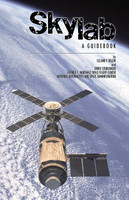
Skylab's launch in 1973 represented a major milestone in America's space program. Intended to enrich scientific knowledge of the Earth, Sun and space, America's first space station was also intended to prove that humans could live and work in zero gravity for extended periods. The station's design originated from a 1959 proposal by Wehrner von Braun to use an empty rocket stage as an orbiting laboratory -- Skylab's Orbital Workshop design was built around a Saturn S-IVB stage. With a total length of about 117 feet and a mass of 169.950 pounds, the station was about the size of an average house. It included a multi-spectral solar observatory, two docking ports, and Airlock Module with EVA hatches, and a large habitation area. Power on-board came from solar arrays and the fuel cells of the docked Apollo CSM. Skylab was damaged by vibrations during lift-off, destroying an important meteoroid shield and one of the station's two solar panel arrays. The second array could not be deployed until the crew of the SL-2 mission made an EVA to fix it. The crew remained in space for 28 days, a record eclipsed by the next two missions SL-3 (59 days) and SL-4 (84 days). After the SL-4 crew returned to the Earth in 1974 plans were made to refurbish Skylab, but delays with the Space Shuttle program proved fatal, and the station re-entered Earth's atmosphere and disintegrated in 1979. Dating from just prior to the station's deployment in 1973, this informative book was originally published by NASA to explain Skylab's mission to the public. Featuring chapters detailing the station's history, design, components, operation, and research projects, it presents an important overview of the Skylab program.
Skylab's launch in 1973 represented a major milestone in America's space program. Intended to enrich scientific knowledge of the Earth, Sun and space, America's first space station was also intended to prove that humans could live and work in zero gravity for extended periods. The station's design originated from a 1959 proposal by Wehrner von Braun to use an empty rocket stage as an orbiting laboratory -- Skylab's Orbital Workshop design was built around a Saturn S-IVB stage. With a total length of about 117 feet and a mass of 169.950 pounds, the station was about the size of an average house. It included a multi-spectral solar observatory, two docking ports, and Airlock Module with EVA hatches, and a large habitation area. Power on-board came from solar arrays and the fuel cells of the docked Apollo CSM. Skylab was damaged by vibrations during lift-off, destroying an important meteoroid shield and one of the station's two solar panel arrays. The second array could not be deployed until the crew of the SL-2 mission made an EVA to fix it. The crew remained in space for 28 days, a record eclipsed by the next two missions SL-3 (59 days) and SL-4 (84 days). After the SL-4 crew returned to the Earth in 1974 plans were made to refurbish Skylab, but delays with the Space Shuttle program proved fatal, and the station re-entered Earth's atmosphere and disintegrated in 1979. Dating from just prior to the station's deployment in 1973, this informative book was originally published by NASA to explain Skylab's mission to the public. Featuring chapters detailing the station's history, design, components, operation, and research projects, it presents an important overview of the Skylab program.
Die US-Raumstation Skylab wurde als einziges vieler ambitionierter Apollo-Nachfolgeprojekte umgesetzt. Von 1973 bis 1974 forschten drei Besatzungen zusammen fast ein halbes Jahr an Bord des...
Several series from the NASA Headquarters Historical Reference Collection have been digitized and made available for use by researchers. Included are PDFs of Press...
Experiments conducted on the Skylab vehicle that will measure and evaluate the ability of the crew to live and work effectively in space are discussed. The methods and techniques of human engineering...
This work has been selected by scholars as being culturally important, and is part of the knowledge base of civilization as we know it. This work was reproduced from the original artifact, and...
This Saturn IB Flight Manual provides launch vehicle systems descriptions and predicted performance data for the Skylab missions. Vehicle SL·2 (SA-206) is the baseline for this manual; but, as a...
Discover your next great read at BookLoop, Australiand online bookstore offering a vast selection of titles across various genres and interests. Whether you're curious about what's trending or searching for graphic novels that captivate, thrilling crime and mystery fiction, or exhilarating action and adventure stories, our curated collections have something for every reader. Delve into imaginative fantasy worlds or explore the realms of science fiction that challenge the boundaries of reality. Fans of contemporary narratives will find compelling stories in our contemporary fiction section. Embark on epic journeys with our fantasy and science fiction titles,
Shop Trending Books and New Releases
Explore our new releases for the most recent additions in romance books, fantasy books, graphic novels, crime and mystery books, science fiction books as well as biographies, cookbooks, self help books, tarot cards, fortunetelling and much more. With titles covering current trends, booktok and bookstagram recommendations, and emerging authors, BookLoop remains your go-to local australian bookstore for buying books online across all book genres.
Shop Best Books By Collection
Stay updated with the literary world by browsing our trending books, featuring the latest bestsellers and critically acclaimed works. Explore titles from popular brands like Minecraft, Pokemon, Star Wars, Bluey, Lonely Planet, ABIA award winners, Peppa Pig, and our specialised collection of ADHD books. At BookLoop, we are committed to providing a diverse and enriching reading experience for all.
Sign In
your cart
Your cart is empty
Menu
Search
PRE-SALES
If you have any questions before making a purchase chat with our online operators to get more information.