Trending Bestseller

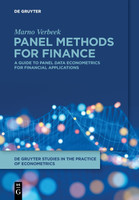
Panel Methods for Finance

Marno Verbeek

No reviews yet Write a Review
Paperback / softback
25 October 2021
$74.00
Ships in 3-5 business days
Hurry up! Current stock:
Financial data are typically characterised by a time-series dimension and a cross-sectional dimension. For example, we may observe financial information on a group of firms over a number of years, or we may observe returns of all stocks traded at NYSE over a period of 120 months. Accordingly, econometric modelling in finance requires appropriate attention to these two -- or occasionally more than two -- dimensions of the data. Panel data techniques are developed to do exactly this. This book provides an overview of commonly applied panel methods for financial applications. The use of panel data has many advantages, in terms of the flexibility of econometric modeling and the ability to control for unobserved heterogeneity. It also involves a number of econometric issues that require specific attention. This includes cross-sectional dependence, robust and clustered standard errors, parameter heterogeneity, fixed effects, dynamic models with a short time dimension, instrumental variables, differences-in-differences and other approaches for causal inference. After an introductory chapter reviewing the classical linear regression model with particular attention to its use in a panel data context, including several standard estimators (pooled OLS, Fama-MacBeth, random effects, first-differences, fixed effects), the book continues with a more elaborate treatment of fixed effects approaches. While first-differencing and fixed effects estimators are attractive because of their removal of time-invariant unobserved heterogeneity (e.g. manager quality, firm culture), consistency of such estimators imposes strict exogeneity of the explanatory variables (for a finite number of time periods). This is often violated in practice, for example, some explanatory variable explaining firm performance may be partly determined by historical firm performance. An obvious case where this assumption is violated arises when the model contains a lagged dependent variable. A separate chapter will focus on dynamic models, which have received specific attention in the literature, also in the context of financial applications, like the dynamics of capital structure choices. Estimation mostly relies on instrumental variables or GMM techniques. Identification and estimation of such models is often fragile, and the small sample properties may be disappointing. The book continues with a chapter on models with limited dependent variables, including binary response models. The cross-sectional dependence that is likely to be present complicates estimation, and the author discusses pooled estimation, random effects and fixed effects approaches, including the possibility to include lagged dependent variables. This chapter will also discuss problems of attrition and sample selection bias, as well as unbalanced panels in general. Identifying causal effects in empirical work based on non-experimental data is often challenging, and causal inference has received substantial attention in the recent literature. The availability of panel data plays an important role in many approaches. Starting with simple differences-in-differences approaches, a dedicated chapter discusses instrumental variables estimators, matching and propensity scores, regression discontinuity and related approaches.

This product hasn't received any reviews yet. Be the first to review this product!

$74.00
Ships in 3-5 business days
Hurry up! Current stock:

Panel Methods for Finance

$74.00

Description

Financial data are typically characterised by a time-series dimension and a cross-sectional dimension. For example, we may observe financial information on a group of firms over a number of years, or we may observe returns of all stocks traded at NYSE over a period of 120 months. Accordingly, econometric modelling in finance requires appropriate attention to these two -- or occasionally more than two -- dimensions of the data. Panel data techniques are developed to do exactly this. This book provides an overview of commonly applied panel methods for financial applications. The use of panel data has many advantages, in terms of the flexibility of econometric modeling and the ability to control for unobserved heterogeneity. It also involves a number of econometric issues that require specific attention. This includes cross-sectional dependence, robust and clustered standard errors, parameter heterogeneity, fixed effects, dynamic models with a short time dimension, instrumental variables, differences-in-differences and other approaches for causal inference. After an introductory chapter reviewing the classical linear regression model with particular attention to its use in a panel data context, including several standard estimators (pooled OLS, Fama-MacBeth, random effects, first-differences, fixed effects), the book continues with a more elaborate treatment of fixed effects approaches. While first-differencing and fixed effects estimators are attractive because of their removal of time-invariant unobserved heterogeneity (e.g. manager quality, firm culture), consistency of such estimators imposes strict exogeneity of the explanatory variables (for a finite number of time periods). This is often violated in practice, for example, some explanatory variable explaining firm performance may be partly determined by historical firm performance. An obvious case where this assumption is violated arises when the model contains a lagged dependent variable. A separate chapter will focus on dynamic models, which have received specific attention in the literature, also in the context of financial applications, like the dynamics of capital structure choices. Estimation mostly relies on instrumental variables or GMM techniques. Identification and estimation of such models is often fragile, and the small sample properties may be disappointing. The book continues with a chapter on models with limited dependent variables, including binary response models. The cross-sectional dependence that is likely to be present complicates estimation, and the author discusses pooled estimation, random effects and fixed effects approaches, including the possibility to include lagged dependent variables. This chapter will also discuss problems of attrition and sample selection bias, as well as unbalanced panels in general. Identifying causal effects in empirical work based on non-experimental data is often challenging, and causal inference has received substantial attention in the recent literature. The availability of panel data plays an important role in many approaches. Starting with simple differences-in-differences approaches, a dedicated chapter discusses instrumental variables estimators, matching and propensity scores, regression discontinuity and related approaches.

Customers Also Viewed

Buy Books Online at BookLoop

Discover your next great read at BookLoop, Australiand online bookstore offering a vast selection of titles across various genres and interests. Whether you're curious about what's trending or searching for graphic novels that captivate, thrilling crime and mystery fiction, or exhilarating action and adventure stories, our curated collections have something for every reader. Delve into imaginative fantasy worlds or explore the realms of science fiction that challenge the boundaries of reality. Fans of contemporary narratives will find compelling stories in our contemporary fiction section. Embark on epic journeys with our fantasy and science fiction titles,

Shop Trending Books and New Releases

Explore our new releases for the most recent additions in romance books, fantasy books, graphic novels, crime and mystery books, science fiction books as well as biographies, cookbooks, self help books, tarot cards, fortunetelling and much more. With titles covering current trends, booktok and bookstagram recommendations, and emerging authors, BookLoop remains your go-to local australian bookstore for buying books online across all book genres.

Shop Best Books By Collection

Stay updated with the literary world by browsing our trending books, featuring the latest bestsellers and critically acclaimed works. Explore titles from popular brands like Minecraft, Pokemon, Star Wars, Bluey, Lonely Planet, ABIA award winners, Peppa Pig, and our specialised collection of ADHD books. At BookLoop, we are committed to providing a diverse and enriching reading experience for all.