Trending Bestseller

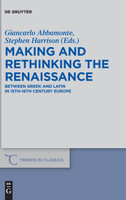
Making and Rethinking the Renaissance

Giancarlo Abbamonte

No reviews yet Write a Review
Hardback
04 June 2019
$268.00
Ships in 3-5 business days
Hurry up! Current stock:
The purpose of this volume is to investigate the crucial role played by the return of knowledge of Greek in the transformation of European culture, both through the translation of texts, and through the direct study of the language. It aims to collect and organize in one database all the digitalised versions of the first editions of Greek grammars, lexica and school texts available in Europe in the 14th and 15th centuries, between two crucial dates: the start of Chrysoloras's teaching in Florence (c. 1397) and the end of the activity of Aldo Manuzio and Andrea Asolano in Venice (c. 1529). This is the first step in a major investigation into the knowledge of Greek and its dissemination in Western Europe: the selection of the texts and the first milestones in teaching methods were put together in that period, through the work of scholars like Chrysoloras, Guarino and many others. A remarkable role was played also by the men involved in the Council of Ferrara (1438-39), where there was a large circulation of Greek books and ideas. About ten years later, Giovanni Tortelli, together with Pope Nicholas V, took the first steps in founding the Vatican Library. Research into the return of the knowledge of Greek to Western Europe has suffered for a long time from the lack of intersection of skills and fields of research: to fully understand this phenomenon, one has to go back a very long way through the tradition of the texts and their reception in contexts as different as the Middle Ages and the beginning of Renaissance humanism. However, over the past thirty years, scholars have demonstrated the crucial role played by the return of knowledge of Greek in the transformation of European culture, both through the translation of texts, and through the direct study of the language. In addition, the actual translations from Greek into Latin remain poorly studied and a clear understanding of the intellectual and cultural contexts that produced them is lacking. In the Middle Ages the knowledge of Greek was limited to isolated areas that had no reciprocal links. As had happened to many Latin authors, all Greek literature was rather neglected, perhaps because a number of philosophical texts had already been available in translation from the seventh century AD, or because of a sense of mistrust, due to their ethnic and religious differences. Between the 12th and 14th century AD, a change is perceptible: the sharp decrease in Greek texts and knowledge in the South of Italy, once a reference-point for this kind of study, was perhaps an important reason prompting Italian humanists to go and study Greek in Constantinople. Over the past thirty years it has become evident to scholars that humanism, through the re-appreciation of classical antiquity, created a bridge to the modern era, which also includes the Middle Ages. The criticism by the humanists of medieval authors did not prevent them from using a number of tools that the Middle Ages had developed or synthesized: glossaries, epitomes, dictionaries, encyclopaedias, translations, commentaries. At present one thing that is missing, however, is a systematic study of the tools used for the study of Greek between the 15th and 16th century; this is truly important, because, in the following centuries, Greek culture provided the basis of European thought in all the most important fields of knowledge. This volume seeks to supply that gap.

This product hasn't received any reviews yet. Be the first to review this product!

$268.00
Ships in 3-5 business days
Hurry up! Current stock:

Making and Rethinking the Renaissance

$268.00

Description

The purpose of this volume is to investigate the crucial role played by the return of knowledge of Greek in the transformation of European culture, both through the translation of texts, and through the direct study of the language. It aims to collect and organize in one database all the digitalised versions of the first editions of Greek grammars, lexica and school texts available in Europe in the 14th and 15th centuries, between two crucial dates: the start of Chrysoloras's teaching in Florence (c. 1397) and the end of the activity of Aldo Manuzio and Andrea Asolano in Venice (c. 1529). This is the first step in a major investigation into the knowledge of Greek and its dissemination in Western Europe: the selection of the texts and the first milestones in teaching methods were put together in that period, through the work of scholars like Chrysoloras, Guarino and many others. A remarkable role was played also by the men involved in the Council of Ferrara (1438-39), where there was a large circulation of Greek books and ideas. About ten years later, Giovanni Tortelli, together with Pope Nicholas V, took the first steps in founding the Vatican Library. Research into the return of the knowledge of Greek to Western Europe has suffered for a long time from the lack of intersection of skills and fields of research: to fully understand this phenomenon, one has to go back a very long way through the tradition of the texts and their reception in contexts as different as the Middle Ages and the beginning of Renaissance humanism. However, over the past thirty years, scholars have demonstrated the crucial role played by the return of knowledge of Greek in the transformation of European culture, both through the translation of texts, and through the direct study of the language. In addition, the actual translations from Greek into Latin remain poorly studied and a clear understanding of the intellectual and cultural contexts that produced them is lacking. In the Middle Ages the knowledge of Greek was limited to isolated areas that had no reciprocal links. As had happened to many Latin authors, all Greek literature was rather neglected, perhaps because a number of philosophical texts had already been available in translation from the seventh century AD, or because of a sense of mistrust, due to their ethnic and religious differences. Between the 12th and 14th century AD, a change is perceptible: the sharp decrease in Greek texts and knowledge in the South of Italy, once a reference-point for this kind of study, was perhaps an important reason prompting Italian humanists to go and study Greek in Constantinople. Over the past thirty years it has become evident to scholars that humanism, through the re-appreciation of classical antiquity, created a bridge to the modern era, which also includes the Middle Ages. The criticism by the humanists of medieval authors did not prevent them from using a number of tools that the Middle Ages had developed or synthesized: glossaries, epitomes, dictionaries, encyclopaedias, translations, commentaries. At present one thing that is missing, however, is a systematic study of the tools used for the study of Greek between the 15th and 16th century; this is truly important, because, in the following centuries, Greek culture provided the basis of European thought in all the most important fields of knowledge. This volume seeks to supply that gap.

Customers Also Viewed

Buy Books Online at BookLoop

Discover your next great read at BookLoop, Australiand online bookstore offering a vast selection of titles across various genres and interests. Whether you're curious about what's trending or searching for graphic novels that captivate, thrilling crime and mystery fiction, or exhilarating action and adventure stories, our curated collections have something for every reader. Delve into imaginative fantasy worlds or explore the realms of science fiction that challenge the boundaries of reality. Fans of contemporary narratives will find compelling stories in our contemporary fiction section. Embark on epic journeys with our fantasy and science fiction titles,

Shop Trending Books and New Releases

Explore our new releases for the most recent additions in romance books, fantasy books, graphic novels, crime and mystery books, science fiction books as well as biographies, cookbooks, self help books, tarot cards, fortunetelling and much more. With titles covering current trends, booktok and bookstagram recommendations, and emerging authors, BookLoop remains your go-to local australian bookstore for buying books online across all book genres.

Shop Best Books By Collection

Stay updated with the literary world by browsing our trending books, featuring the latest bestsellers and critically acclaimed works. Explore titles from popular brands like Minecraft, Pokemon, Star Wars, Bluey, Lonely Planet, ABIA award winners, Peppa Pig, and our specialised collection of ADHD books. At BookLoop, we are committed to providing a diverse and enriching reading experience for all.