
Trending Bestseller

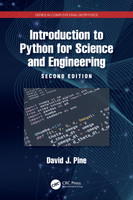
Introduction to Python for Science and Engineering

No reviews yet Write a Review
Paperback / softback
23 September 2024
420 Pages
RRP: $123.99
$123.00
Hurry up! Current stock:

Introduction to Python for Science and Engineering offers a quick and incisive introduction to the Python programming language for use in any science or engineering discipline. The approach is pedagogical and “bottom up,” which means starting with examples and extracting more general principles from that experience. No prior programming experience is assumed.

Readers will learn the basics of Python syntax, data structures, input and output, conditionals and loops, user-defined functions, plotting, animation, and visualization. They will also learn how to use Python for numerical analysis, including curve fitting, random numbers, linear algebra, solutions to nonlinear equations, numerical integration, solutions to differential equations, and fast Fourier transforms.

Readers learn how to interact and program with Python using JupyterLab and Spyder, two simple and widely used integrated development environments.

All the major Python libraries for science and engineering are covered, including NumPy, SciPy, Matplotlib, and Pandas. Other packages are also introduced, including Numba, which can render Python numerical calculations as fast as compiled computer languages such as C but without their complex overhead.

You Can Find This Book In

    Book Details
    ISBN-13
    9781032673905
    Author
    David J. Pine
    Publisher
    CRC Press
    Published
    23 September 2024
    Format
    Paperback / softback
    Pages
    420

    This product hasn't received any reviews yet. Be the first to review this product!

    RRP: $123.99
    $123.00
    Hurry up! Current stock:

    Introduction to Python for Science and Engineering

    RRP: $123.99
    $123.00

    Description

    Introduction to Python for Science and Engineering offers a quick and incisive introduction to the Python programming language for use in any science or engineering discipline. The approach is pedagogical and “bottom up,” which means starting with examples and extracting more general principles from that experience. No prior programming experience is assumed.

    Readers will learn the basics of Python syntax, data structures, input and output, conditionals and loops, user-defined functions, plotting, animation, and visualization. They will also learn how to use Python for numerical analysis, including curve fitting, random numbers, linear algebra, solutions to nonlinear equations, numerical integration, solutions to differential equations, and fast Fourier transforms.

    Readers learn how to interact and program with Python using JupyterLab and Spyder, two simple and widely used integrated development environments.

    All the major Python libraries for science and engineering are covered, including NumPy, SciPy, Matplotlib, and Pandas. Other packages are also introduced, including Numba, which can render Python numerical calculations as fast as compiled computer languages such as C but without their complex overhead.

    You Can Find This Book In

      This Book Is Categorised As