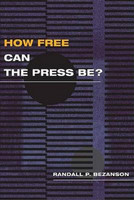
The First Amendment to the Constitution states that Congress shall make no law abridging the freedom of the press, but the definitions of ''press,'' of ''freedom,'' and even of ''abridgment'' have evolved by means of judicial rulings on cases concerning the limits and purposes of press freedoms. In How Free Can the Press Be? Randall P. Bezanson explores the changes in understanding of press freedom in America by discussing in depth nine of the most pivotal and provocative First Amendment cases in U.S. judicial history. These cases were argued before the U.S. Supreme Court, state Supreme Courts, and even a local circuit court, and concerned matters ranging from The New York Times's publication of the Pentagon Papers to Hugo Zacchini, the human cannonball who claimed television broadcasts of his act threatened his livelihood. Other cases include a politician blackballed by the Miami Herald and prevented from responding in its pages, the Pittsburgh Press arguing it had the right to employ gender-based column headings in its classified ads section, and the victim of a crime suing the Des Moines Register over that paper's publication of intimate details, including the victim's name. Each case resulted in a ruling that refined or reshaped judicial definition of the limits of press freedom.Does the First Amendment give the press a special position under the law? Is editorial judgment a cornerstone of the press? Does the press have a duty to publish truth and fact, to present both sides of a story, to respect the privacy of individuals, to obtain its information through legally acceptable means? How does press freedom weigh against national security? Bezanson addresses these and other questions, examining the arguments on both sides, and using these landmark cases as a springboard for a wider discussion of the meaning and limits of press freedom.
The First Amendment to the Constitution states that Congress shall make no law abridging the freedom of the press, but the definitions of ''press,'' of ''freedom,'' and even of ''abridgment'' have evolved by means of judicial rulings on cases concerning the limits and purposes of press freedoms. In How Free Can the Press Be? Randall P. Bezanson explores the changes in understanding of press freedom in America by discussing in depth nine of the most pivotal and provocative First Amendment cases in U.S. judicial history. These cases were argued before the U.S. Supreme Court, state Supreme Courts, and even a local circuit court, and concerned matters ranging from The New York Times's publication of the Pentagon Papers to Hugo Zacchini, the human cannonball who claimed television broadcasts of his act threatened his livelihood. Other cases include a politician blackballed by the Miami Herald and prevented from responding in its pages, the Pittsburgh Press arguing it had the right to employ gender-based column headings in its classified ads section, and the victim of a crime suing the Des Moines Register over that paper's publication of intimate details, including the victim's name. Each case resulted in a ruling that refined or reshaped judicial definition of the limits of press freedom.Does the First Amendment give the press a special position under the law? Is editorial judgment a cornerstone of the press? Does the press have a duty to publish truth and fact, to present both sides of a story, to respect the privacy of individuals, to obtain its information through legally acceptable means? How does press freedom weigh against national security? Bezanson addresses these and other questions, examining the arguments on both sides, and using these landmark cases as a springboard for a wider discussion of the meaning and limits of press freedom.
This is a reproduction of a book published before 1923. This book may have occasional imperfections such as missing or blurred pages, poor pictures, errant marks,...
Tracking the relationship between the theory of press control and the realities of practicing daily press censorship prior to publication, this volume on the suppression of dissent in early modern...
In this satirical novel, Hilaire Belloc takes on the corruption and sensationalism of the newspaper industry at the turn of the century. Through the character of Avril, a young journalist trying to...
Discover your next great read at BookLoop, Australiand online bookstore offering a vast selection of titles across various genres and interests. Whether you're curious about what's trending or searching for graphic novels that captivate, thrilling crime and mystery fiction, or exhilarating action and adventure stories, our curated collections have something for every reader. Delve into imaginative fantasy worlds or explore the realms of science fiction that challenge the boundaries of reality. Fans of contemporary narratives will find compelling stories in our contemporary fiction section. Embark on epic journeys with our fantasy and science fiction titles,
Shop Trending Books and New Releases
Explore our new releases for the most recent additions in romance books, fantasy books, graphic novels, crime and mystery books, science fiction books as well as biographies, cookbooks, self help books, tarot cards, fortunetelling and much more. With titles covering current trends, booktok and bookstagram recommendations, and emerging authors, BookLoop remains your go-to local australian bookstore for buying books online across all book genres.
Shop Best Books By Collection
Stay updated with the literary world by browsing our trending books, featuring the latest bestsellers and critically acclaimed works. Explore titles from popular brands like Minecraft, Pokemon, Star Wars, Bluey, Lonely Planet, ABIA award winners, Peppa Pig, and our specialised collection of ADHD books. At BookLoop, we are committed to providing a diverse and enriching reading experience for all.
Sign In
your cart
Your cart is empty
Menu
Search
PRE-SALES
If you have any questions before making a purchase chat with our online operators to get more information.