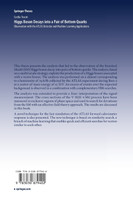
The discovery in 2012 of the Higgs boson at the Large Hadron Collider (LHC) represents a milestone for the Standard Model (SM) of particle physics. Most of the SM Higgs production and decay rates have been measured at the LHC with increased precision. However, despite its experimental success, the SM is known to be only an effective manifestation of a more fundamental description of nature. The scientific research at the LHC is strongly focused on extending the SM by searching, directly or indirectly, for indications of New Physics. The extensive physics program requires increasingly advanced computational and algorithmic techniques. In the last decades, Machine Learning (ML) methods have made a prominent appearance in the field of particle physics, and promise to address many challenges faced by the LHC. This thesis presents the analysis that led to the observation of the SM Higgs boson decay into pairs of bottom quarks. The analysis exploits the production of a Higgs boson associated with a vector boson whose signatures enable efficient triggering and powerful background reduction. The main strategy to maximise the signal sensitivity is based on a multivariate approach. The analysis is performed on a dataset corresponding to a luminosity of 79.8/fb collected by the ATLAS experiment during Run-2 at a centre-of-mass energy of 13 TeV. An excess of events over the expected background is found with an observed (expected) significance of 4.9 (4.3) standard deviation. A combination with results from other \Hbb searches provides an observed (expected) significance of 5.4 (5.5). The corresponding ratio between the signal yield and the SM expectation is 1.01 +- 0.12 (stat.)+ 0.16-0.15(syst.). The 'observation' analysis was further extended to provide a finer interpretation of the V H(H → bb) signal measurement. The cross sections for the VH production times the H → bb branching ratio have been measured in exclusive regions of phase space. These measurements are used to search for possible deviations from the SM with an effective field theory approach, based on anomalous couplings of the Higgs boson. The results of the cross-section measurements, as well as the constraining of the operators that affect the couplings of the Higgs boson to the vector boson and the bottom quarks, have been documented and discussed in this thesis. This thesis also describes a novel technique for the fast simulation of the forward calorimeter response, based on similarity search methods. Such techniques constitute a branch of ML and include clustering and indexing methods that enable quick and efficient searches for vectors similar to each other. The new simulation approach provides optimal results in terms of detector resolution response and reduces the computational requirements of a standard particles simulation.
The discovery in 2012 of the Higgs boson at the Large Hadron Collider (LHC) represents a milestone for the Standard Model (SM) of particle physics. Most of the SM Higgs production and decay rates have been measured at the LHC with increased precision. However, despite its experimental success, the SM is known to be only an effective manifestation of a more fundamental description of nature. The scientific research at the LHC is strongly focused on extending the SM by searching, directly or indirectly, for indications of New Physics. The extensive physics program requires increasingly advanced computational and algorithmic techniques. In the last decades, Machine Learning (ML) methods have made a prominent appearance in the field of particle physics, and promise to address many challenges faced by the LHC. This thesis presents the analysis that led to the observation of the SM Higgs boson decay into pairs of bottom quarks. The analysis exploits the production of a Higgs boson associated with a vector boson whose signatures enable efficient triggering and powerful background reduction. The main strategy to maximise the signal sensitivity is based on a multivariate approach. The analysis is performed on a dataset corresponding to a luminosity of 79.8/fb collected by the ATLAS experiment during Run-2 at a centre-of-mass energy of 13 TeV. An excess of events over the expected background is found with an observed (expected) significance of 4.9 (4.3) standard deviation. A combination with results from other \Hbb searches provides an observed (expected) significance of 5.4 (5.5). The corresponding ratio between the signal yield and the SM expectation is 1.01 +- 0.12 (stat.)+ 0.16-0.15(syst.). The 'observation' analysis was further extended to provide a finer interpretation of the V H(H → bb) signal measurement. The cross sections for the VH production times the H → bb branching ratio have been measured in exclusive regions of phase space. These measurements are used to search for possible deviations from the SM with an effective field theory approach, based on anomalous couplings of the Higgs boson. The results of the cross-section measurements, as well as the constraining of the operators that affect the couplings of the Higgs boson to the vector boson and the bottom quarks, have been documented and discussed in this thesis. This thesis also describes a novel technique for the fast simulation of the forward calorimeter response, based on similarity search methods. Such techniques constitute a branch of ML and include clustering and indexing methods that enable quick and efficient searches for vectors similar to each other. The new simulation approach provides optimal results in terms of detector resolution response and reduces the computational requirements of a standard particles simulation.
This thesis reports on the search for dark matter in data taken with the ATLAS detector at CERN's Large Hadron Collider (LHC). The identification of dark matter and the determination of its...
During Run 2 of the Large Hadron Collider, the ATLAS experiment recorded proton-proton collision events at 13 TeV, the highest energy ever achieved in a collider. Analysis of this dataset has...
This thesis describes the stand-alone discovery and measurement of the Higgs boson in its decays to two W bosons using the Run-I ATLAS dataset. This is the most precise measurement of gluon-fusion...
In this work, the interaction between the Higgs boson and the top quark is studied with the proton-proton collisions at 13 TeV provided by the LHC at the CMS detector at CERN (Geneva). At the LHC,...
Discover your next great read at BookLoop, Australiand online bookstore offering a vast selection of titles across various genres and interests. Whether you're curious about what's trending or searching for graphic novels that captivate, thrilling crime and mystery fiction, or exhilarating action and adventure stories, our curated collections have something for every reader. Delve into imaginative fantasy worlds or explore the realms of science fiction that challenge the boundaries of reality. Fans of contemporary narratives will find compelling stories in our contemporary fiction section. Embark on epic journeys with our fantasy and science fiction titles,
Shop Trending Books and New Releases
Explore our new releases for the most recent additions in romance books, fantasy books, graphic novels, crime and mystery books, science fiction books as well as biographies, cookbooks, self help books, tarot cards, fortunetelling and much more. With titles covering current trends, booktok and bookstagram recommendations, and emerging authors, BookLoop remains your go-to local australian bookstore for buying books online across all book genres.
Shop Best Books By Collection
Stay updated with the literary world by browsing our trending books, featuring the latest bestsellers and critically acclaimed works. Explore titles from popular brands like Minecraft, Pokemon, Star Wars, Bluey, Lonely Planet, ABIA award winners, Peppa Pig, and our specialised collection of ADHD books. At BookLoop, we are committed to providing a diverse and enriching reading experience for all.
Sign In
your cart
Your cart is empty
Menu
Search
PRE-SALES
If you have any questions before making a purchase chat with our online operators to get more information.