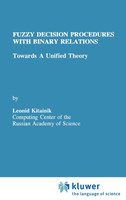
In decision theory there are basically two appr~hes to the modeling of individual choice: one is based on an absolute representation of preferences leading to a ntDnerical expression of preference intensity. This is utility theory. Another approach is based on binary relations that encode pairwise preference. While the former has mainly blossomed in the Anglo-Saxon academic world, the latter is mostly advocated in continental Europe, including Russia. The advantage of the utility theory approach is that it integrates uncertainty about the state of nature, that may affect the consequences of decision. Then, the problems of choice and ranking from the knowledge of preferences become trivial once the utility function is known. In the case of the relational approach, the model does not explicitly accounts for uncertainty, hence it looks less sophisticated. On the other hand it is more descriptive than normative in the first stand because it takes the pairwise preference pattern expressed by the decision-maker as it is and tries to make the best out of it. Especially the preference relation is not supposed to have any property. The main problem with the utility theory approach is the gap between what decision-makers are and can express, and what the theory would like them to be and to be capable of expressing. With the relational approach this gap does not exist, but the main difficulty is now to build up convincing choice rules and ranking rules that may help the decision process.
In decision theory there are basically two appr~hes to the modeling of individual choice: one is based on an absolute representation of preferences leading to a ntDnerical expression of preference intensity. This is utility theory. Another approach is based on binary relations that encode pairwise preference. While the former has mainly blossomed in the Anglo-Saxon academic world, the latter is mostly advocated in continental Europe, including Russia. The advantage of the utility theory approach is that it integrates uncertainty about the state of nature, that may affect the consequences of decision. Then, the problems of choice and ranking from the knowledge of preferences become trivial once the utility function is known. In the case of the relational approach, the model does not explicitly accounts for uncertainty, hence it looks less sophisticated. On the other hand it is more descriptive than normative in the first stand because it takes the pairwise preference pattern expressed by the decision-maker as it is and tries to make the best out of it. Especially the preference relation is not supposed to have any property. The main problem with the utility theory approach is the gap between what decision-makers are and can express, and what the theory would like them to be and to be capable of expressing. With the relational approach this gap does not exist, but the main difficulty is now to build up convincing choice rules and ranking rules that may help the decision process.
For someone with a hammer the whole world looks like a nail. Within the last 10-13 years Binar·y Decision Diagmms (BDDs) have become the state-of-the-art data structure in VLSI CAD for representation...
This book describes some models from the theory of investment which are mainly characterized by three features. Firstly, the decision-maker acts in a dynamic environment. Secondly, the distributions...
The book introduces readers to some of the latest advances in and approaches to decision-making methods based on thermodynamic characters and hesitant fuzzy linguistic preference relations. By...
Discover your next great read at BookLoop, Australiand online bookstore offering a vast selection of titles across various genres and interests. Whether you're curious about what's trending or searching for graphic novels that captivate, thrilling crime and mystery fiction, or exhilarating action and adventure stories, our curated collections have something for every reader. Delve into imaginative fantasy worlds or explore the realms of science fiction that challenge the boundaries of reality. Fans of contemporary narratives will find compelling stories in our contemporary fiction section. Embark on epic journeys with our fantasy and science fiction titles,
Shop Trending Books and New Releases
Explore our new releases for the most recent additions in romance books, fantasy books, graphic novels, crime and mystery books, science fiction books as well as biographies, cookbooks, self help books, tarot cards, fortunetelling and much more. With titles covering current trends, booktok and bookstagram recommendations, and emerging authors, BookLoop remains your go-to local australian bookstore for buying books online across all book genres.
Shop Best Books By Collection
Stay updated with the literary world by browsing our trending books, featuring the latest bestsellers and critically acclaimed works. Explore titles from popular brands like Minecraft, Pokemon, Star Wars, Bluey, Lonely Planet, ABIA award winners, Peppa Pig, and our specialised collection of ADHD books. At BookLoop, we are committed to providing a diverse and enriching reading experience for all.
Sign In
your cart
Your cart is empty
Menu
Search
PRE-SALES
If you have any questions before making a purchase chat with our online operators to get more information.