This textbook teaches advanced undergraduate and first-year graduate students in Engineering and Applied Sciences to gather and analyze empirical observations (data) in order to aid in making design decisions. While science is about discovery, the primary paradigm of engineering and "applied science" is design. Scientists are in the discovery business and want, in general, to understand the natural world rather than to alter it. In contrast, engineers and applied scientists design products, processes, and solutions to problems. That said, statistics, as a discipline, is mostly oriented toward the discovery paradigm. Young engineers come out of their degree programs having taken courses such as "Statistics for Engineers and Scientists" without any clear idea as to how they can use statistical methods to help them design products or processes. Many seem to think that statistics is only useful for demonstrating that a device or process actually does what it was designed to do. Statistics courses emphasize creating predictive or classification models - predicting nature or classifying individuals, and statistics is often used to prove or disprove phenomena as opposed to aiding in the design of a product or process. In industry however, Chemical Engineers use designed experiments to optimize petroleum extraction; Manufacturing Engineers use experimental data to optimize machine operation; Industrial Engineers might use data to determine the optimal number of operators required in a manual assembly process. This text teaches engineering and applied science students to incorporate empirical investigation into such design processes.
Much of the discussion in this book is about models, not whether the models truly represent reality but whether they adequately represent reality with respect to the problems at hand; many ideas focus on how to gather data in the most efficient way possible to construct adequate models.
Includes chapters on subjects not often seen together in a single text (e.g., measurement systems, mixture experiments, logistic regression, Taguchi methods, simulation)
Techniques and concepts introduced present a wide variety of design situations familiar to engineers and applied scientists and inspire incorporation of experimentation and empirical investigation into the design process.
Software is integrally linked to statistical analyses with fully worked examples in each chapter; fully worked using several packages: SAS, R, JMP, Minitab, and MS Excel - also including discussion questions at the end of each chapter.
The fundamental learning objective of this textbook is for the reader to understand how experimental data can be used to make design decisions and to be familiar with the most common types of experimental designs and analysis methods.
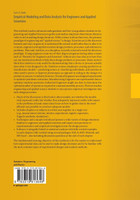
Empirical Modeling and Data Analysis for Engineers and Applied Scientists
RRP:
$151.00
Description
This textbook teaches advanced undergraduate and first-year graduate students in Engineering and Applied Sciences to gather and analyze empirical observations (data) in order to aid in making design decisions. While science is about discovery, the primary paradigm of engineering and "applied science" is design. Scientists are in the discovery business and want, in general, to understand the natural world rather than to alter it. In contrast, engineers and applied scientists design products, processes, and solutions to problems. That said, statistics, as a discipline, is mostly oriented toward the discovery paradigm. Young engineers come out of their degree programs having taken courses such as "Statistics for Engineers and Scientists" without any clear idea as to how they can use statistical methods to help them design products or processes. Many seem to think that statistics is only useful for demonstrating that a device or process actually does what it was designed to do. Statistics courses emphasize creating predictive or classification models - predicting nature or classifying individuals, and statistics is often used to prove or disprove phenomena as opposed to aiding in the design of a product or process. In industry however, Chemical Engineers use designed experiments to optimize petroleum extraction; Manufacturing Engineers use experimental data to optimize machine operation; Industrial Engineers might use data to determine the optimal number of operators required in a manual assembly process. This text teaches engineering and applied science students to incorporate empirical investigation into such design processes.
Much of the discussion in this book is about models, not whether the models truly represent reality but whether they adequately represent reality with respect to the problems at hand; many ideas focus on how to gather data in the most efficient way possible to construct adequate models.
Includes chapters on subjects not often seen together in a single text (e.g., measurement systems, mixture experiments, logistic regression, Taguchi methods, simulation)
Techniques and concepts introduced present a wide variety of design situations familiar to engineers and applied scientists and inspire incorporation of experimentation and empirical investigation into the design process.
Software is integrally linked to statistical analyses with fully worked examples in each chapter; fully worked using several packages: SAS, R, JMP, Minitab, and MS Excel - also including discussion questions at the end of each chapter.
The fundamental learning objective of this textbook is for the reader to understand how experimental data can be used to make design decisions and to be familiar with the most common types of experimental designs and analysis methods.
BIG DATA, ARTIFICIAL INTELLIGENCE AND DATA ANALYSIS SET Coordinated by Jacques Janssen Data analysis is a scientific field that continues to grow enormously, most notably over the last few decades,...
BIG DATA, ARTIFICIAL INTELLIGENCE AND DATA ANALYSIS SET Coordinated by Jacques Janssen Data analysis is a scientific field that continues to grow enormously, most notably over the last few decades,...
Discover your next great read at BookLoop, Australiand online bookstore offering a vast selection of titles across various genres and interests. Whether you're curious about what's trending or searching for graphic novels that captivate, thrilling crime and mystery fiction, or exhilarating action and adventure stories, our curated collections have something for every reader. Delve into imaginative fantasy worlds or explore the realms of science fiction that challenge the boundaries of reality. Fans of contemporary narratives will find compelling stories in our contemporary fiction section. Embark on epic journeys with our fantasy and science fiction titles,
Shop Trending Books and New Releases
Explore our new releases for the most recent additions in romance books, fantasy books, graphic novels, crime and mystery books, science fiction books as well as biographies, cookbooks, self help books, tarot cards, fortunetelling and much more. With titles covering current trends, booktok and bookstagram recommendations, and emerging authors, BookLoop remains your go-to local australian bookstore for buying books online across all book genres.
Shop Best Books By Collection
Stay updated with the literary world by browsing our trending books, featuring the latest bestsellers and critically acclaimed works. Explore titles from popular brands like Minecraft, Pokemon, Star Wars, Bluey, Lonely Planet, ABIA award winners, Peppa Pig, and our specialised collection of ADHD books. At BookLoop, we are committed to providing a diverse and enriching reading experience for all.
Sign In
your cart
Your cart is empty
Menu
Search
PRE-SALES
If you have any questions before making a purchase chat with our online operators to get more information.