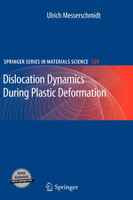
Very many structural materials like metals and ceramics are of crystalline nature.Undermostoftheconditions,theyundergoplasticdeformationbefore they fail under load. The plastic deformation is mediated by the gene- tion and motion of one-dimensional crystal defects, the so-called dislocations. Thus, the density and dynamic properties of the dislocations determine the plastic behavior of the respective materials and frequently also their failure. Thedislocationdynamics,that is,the responseofthedislocationsto anext- nal load, is controlled by the interaction between the moving dislocations with the periodic crystal lattice structure, other crystal defects from point defects oversmall clusters to largerprecipitates, with other dislocations fo- ing a microstructure through which the mobile dislocations have to move, and ?nally the grain and phase structure of the material. Considering these di?erent interactions, the dislocation motion turns out to be quite a complex process. In situ straining experiments in a transmission electron microscope are a powerful means for studying the microprocesses controlling the dislocation mobility. With this method, dislocations candirectly be observedduring their motionunderload.Thetechniqueadvancedwhenhigh-voltageelectronmic- scopes became commercially available at the end of the 1960s, ?rst in Japan and later on also in other countries. These microscopes enable the transm- sion of thicker specimens, which have properties similar to macroscopic bulk specimens.Besides,they o?ersu?cientroomfor elaboratedeformationstages in the specimen chamber. In the last 30 years, in situ straining experiments were performed on many materials, both in conventional and in high-voltage electron microscopes. The present author and his coworkers performed such experiments over about 30 years, yielding many hours of video recordings of dislocation motion.
Very many structural materials like metals and ceramics are of crystalline nature.Undermostoftheconditions,theyundergoplasticdeformationbefore they fail under load. The plastic deformation is mediated by the gene- tion and motion of one-dimensional crystal defects, the so-called dislocations. Thus, the density and dynamic properties of the dislocations determine the plastic behavior of the respective materials and frequently also their failure. Thedislocationdynamics,that is,the responseofthedislocationsto anext- nal load, is controlled by the interaction between the moving dislocations with the periodic crystal lattice structure, other crystal defects from point defects oversmall clusters to largerprecipitates, with other dislocations fo- ing a microstructure through which the mobile dislocations have to move, and ?nally the grain and phase structure of the material. Considering these di?erent interactions, the dislocation motion turns out to be quite a complex process. In situ straining experiments in a transmission electron microscope are a powerful means for studying the microprocesses controlling the dislocation mobility. With this method, dislocations candirectly be observedduring their motionunderload.Thetechniqueadvancedwhenhigh-voltageelectronmic- scopes became commercially available at the end of the 1960s, ?rst in Japan and later on also in other countries. These microscopes enable the transm- sion of thicker specimens, which have properties similar to macroscopic bulk specimens.Besides,they o?ersu?cientroomfor elaboratedeformationstages in the specimen chamber. In the last 30 years, in situ straining experiments were performed on many materials, both in conventional and in high-voltage electron microscopes. The present author and his coworkers performed such experiments over about 30 years, yielding many hours of video recordings of dislocation motion.
This proceedings volume, "Plastic Deformation of Ceramics," constitutes the papers of an international symposium held at Snowbird, Utah from August 7-12, 1994. It was attended by nearly 100...
This thesis transports you to a wonderful and fascinating small-scale world and tells you the origin of several new phenomena. The investigative tool is the improved discrete dislocation-based...
Discover your next great read at BookLoop, Australiand online bookstore offering a vast selection of titles across various genres and interests. Whether you're curious about what's trending or searching for graphic novels that captivate, thrilling crime and mystery fiction, or exhilarating action and adventure stories, our curated collections have something for every reader. Delve into imaginative fantasy worlds or explore the realms of science fiction that challenge the boundaries of reality. Fans of contemporary narratives will find compelling stories in our contemporary fiction section. Embark on epic journeys with our fantasy and science fiction titles,
Shop Trending Books and New Releases
Explore our new releases for the most recent additions in romance books, fantasy books, graphic novels, crime and mystery books, science fiction books as well as biographies, cookbooks, self help books, tarot cards, fortunetelling and much more. With titles covering current trends, booktok and bookstagram recommendations, and emerging authors, BookLoop remains your go-to local australian bookstore for buying books online across all book genres.
Shop Best Books By Collection
Stay updated with the literary world by browsing our trending books, featuring the latest bestsellers and critically acclaimed works. Explore titles from popular brands like Minecraft, Pokemon, Star Wars, Bluey, Lonely Planet, ABIA award winners, Peppa Pig, and our specialised collection of ADHD books. At BookLoop, we are committed to providing a diverse and enriching reading experience for all.
Sign In
your cart
Your cart is empty
Menu
Search
PRE-SALES
If you have any questions before making a purchase chat with our online operators to get more information.