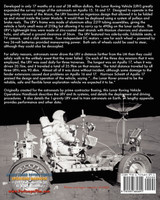
Developed in only 17 months at a cost of 38 million dollars, the Lunar Roving Vehicle (LRV) greatly expanded the survey range of the astronauts on Apollo 15, 16 and 17. Designed to operate in the low-gravity vacuum of the Moon, the LRV boasted an ingenious design that allowed it to be folded up and stored inside the Lunar Module. It would then be deployed using a system of pulleys and brake reels. The LRV's frame was made of aluminum alloy 2219 tubing assemblies, giving the vehicle a fairly small mass of 210kg but allowing it to carry up to 490kg on the lunar surface. The LRV's lightweight tires were made of zinc-coated steel strands with titanium chevrons and aluminum hubs, and offered a ground clearance of 36cm. The LRV featured two side-by-side, foldable seats, a TV camera, and a dish antenna. Four independent DC motors - one for each wheel - powered by two 36-volt batteries provided maneuvering power. Both sets of wheels could be used to steer, although they could also be decoupled. For safety reasons, astronauts never drove the LRV a distance farther from the LM than they could safely walk in the unlikely event that the rover failed. On each of the three day missions that it was employed, the LRV was used daily for three traverses. The longest was on Apollo 17, when it was driven 20.1km, and it traveled a total of 35.9km on that mission. The total distance traveled by all three LRVs was 90.4km. Almost all of it was done without incident, although some damage to the fender extensions caused dust problems on Apollo 16 and 17. Harrison Schmitt of Apollo 17 praised the design and operation of the vehicle, saying "...the Lunar Rover proved to be the reliable, safe and flexible lunar exploration vehicle we expected it to be." Originally created for the astronauts by prime contractor Boeing, this Lunar Roving Vehicle Operations Handbook describes the LRV and its systems, and details the deployment and driving procedures. It also details the 1-gravity LRV used to train astronauts on Earth. A lengthy appendix provides performance and other data.
Developed in only 17 months at a cost of 38 million dollars, the Lunar Roving Vehicle (LRV) greatly expanded the survey range of the astronauts on Apollo 15, 16 and 17. Designed to operate in the low-gravity vacuum of the Moon, the LRV boasted an ingenious design that allowed it to be folded up and stored inside the Lunar Module. It would then be deployed using a system of pulleys and brake reels. The LRV's frame was made of aluminum alloy 2219 tubing assemblies, giving the vehicle a fairly small mass of 210kg but allowing it to carry up to 490kg on the lunar surface. The LRV's lightweight tires were made of zinc-coated steel strands with titanium chevrons and aluminum hubs, and offered a ground clearance of 36cm. The LRV featured two side-by-side, foldable seats, a TV camera, and a dish antenna. Four independent DC motors - one for each wheel - powered by two 36-volt batteries provided maneuvering power. Both sets of wheels could be used to steer, although they could also be decoupled. For safety reasons, astronauts never drove the LRV a distance farther from the LM than they could safely walk in the unlikely event that the rover failed. On each of the three day missions that it was employed, the LRV was used daily for three traverses. The longest was on Apollo 17, when it was driven 20.1km, and it traveled a total of 35.9km on that mission. The total distance traveled by all three LRVs was 90.4km. Almost all of it was done without incident, although some damage to the fender extensions caused dust problems on Apollo 16 and 17. Harrison Schmitt of Apollo 17 praised the design and operation of the vehicle, saying "...the Lunar Rover proved to be the reliable, safe and flexible lunar exploration vehicle we expected it to be." Originally created for the astronauts by prime contractor Boeing, this Lunar Roving Vehicle Operations Handbook describes the LRV and its systems, and details the deployment and driving procedures. It also details the 1-gravity LRV used to train astronauts on Earth. A lengthy appendix provides performance and other data.
The objectives of this slide presentation are to review the activities on the lunar surface during the stay. The objectives include (1) Summarize Lunar Module Basics emphasizing module layout and...
The result of eighteen years of design and research, the A7L and A7LB spacesuits served during the Apollo, Skylab and Apollo-Soyuz missions. Designed by International Latex Corporation (ILC) Dover...
Objectives include: a) Describe LM Electrical System original specifications; b) Describe the decision to change from fuel cells to batteries and other changes; c) Describe the Electrical system; and...
This work has been selected by scholars as being culturally important and is part of the knowledge base of civilization as we know it.This work is in the public domain in the United States of...
Discover your next great read at BookLoop, Australiand online bookstore offering a vast selection of titles across various genres and interests. Whether you're curious about what's trending or searching for graphic novels that captivate, thrilling crime and mystery fiction, or exhilarating action and adventure stories, our curated collections have something for every reader. Delve into imaginative fantasy worlds or explore the realms of science fiction that challenge the boundaries of reality. Fans of contemporary narratives will find compelling stories in our contemporary fiction section. Embark on epic journeys with our fantasy and science fiction titles,
Shop Trending Books and New Releases
Explore our new releases for the most recent additions in romance books, fantasy books, graphic novels, crime and mystery books, science fiction books as well as biographies, cookbooks, self help books, tarot cards, fortunetelling and much more. With titles covering current trends, booktok and bookstagram recommendations, and emerging authors, BookLoop remains your go-to local australian bookstore for buying books online across all book genres.
Shop Best Books By Collection
Stay updated with the literary world by browsing our trending books, featuring the latest bestsellers and critically acclaimed works. Explore titles from popular brands like Minecraft, Pokemon, Star Wars, Bluey, Lonely Planet, ABIA award winners, Peppa Pig, and our specialised collection of ADHD books. At BookLoop, we are committed to providing a diverse and enriching reading experience for all.
Sign In
your cart
Your cart is empty
Menu
Search
PRE-SALES
If you have any questions before making a purchase chat with our online operators to get more information.