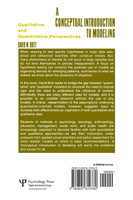
When seeking to test specific hypotheses in large data sets, social and behavioral scientists often construct models. Although useful in such situations, many phenomena of interest do not occur in large samples and do not lend themselves to precise measurement. In addition, a focus on hypothesis testing can constrict the potential use of models as organizing devices for emerging patterns -- summaries of what we believe we know about the dynamics of situation. This book bridges the gap between "quantitative" and "qualitative" modelers to reconcile the need to impose rigor and to understand the influence of context. Although there are many different uses for models, there is also the realistic possibility of doing credible research without their use. A critical reexamination of the assumptions used in quantitatively-oriented models, however, suggests ways to increase their effectiveness as organizers of both quantitative and qualitative data. Students of methods in psychology, sociology, education, management, social work, and public health -- and their instructors -- are increasingly expected to become familiar with both quantitative and qualitative approaches. Unfortunately, they find few vehicles for communication regarding the implications of overlapping work between the two approaches. Using models as organizing devices for a better dialogue between assumptions and data might facilitate this communication process.
When seeking to test specific hypotheses in large data sets, social and behavioral scientists often construct models. Although useful in such situations, many phenomena of interest do not occur in large samples and do not lend themselves to precise measurement. In addition, a focus on hypothesis testing can constrict the potential use of models as organizing devices for emerging patterns -- summaries of what we believe we know about the dynamics of situation. This book bridges the gap between "quantitative" and "qualitative" modelers to reconcile the need to impose rigor and to understand the influence of context. Although there are many different uses for models, there is also the realistic possibility of doing credible research without their use. A critical reexamination of the assumptions used in quantitatively-oriented models, however, suggests ways to increase their effectiveness as organizers of both quantitative and qualitative data. Students of methods in psychology, sociology, education, management, social work, and public health -- and their instructors -- are increasingly expected to become familiar with both quantitative and qualitative approaches. Unfortunately, they find few vehicles for communication regarding the implications of overlapping work between the two approaches. Using models as organizing devices for a better dialogue between assumptions and data might facilitate this communication process.
This volume contains a collection of selected papers presented at the Symposium on Conceptual Modeling, which was held in Los Angeles, California, on December 2, th 1997, immediately before the 16...
The objective of the workshops associated with the ER'99 18th International Conference on Conceptual Modeling is to give participants access to high level presentations on specialized, hot, or...
Conceptual modeling has always been one of the main issues in information systems engineering as it aims to describe the general knowledge of the system at an abstract level that facilitates user...
Discover your next great read at BookLoop, Australiand online bookstore offering a vast selection of titles across various genres and interests. Whether you're curious about what's trending or searching for graphic novels that captivate, thrilling crime and mystery fiction, or exhilarating action and adventure stories, our curated collections have something for every reader. Delve into imaginative fantasy worlds or explore the realms of science fiction that challenge the boundaries of reality. Fans of contemporary narratives will find compelling stories in our contemporary fiction section. Embark on epic journeys with our fantasy and science fiction titles,
Shop Trending Books and New Releases
Explore our new releases for the most recent additions in romance books, fantasy books, graphic novels, crime and mystery books, science fiction books as well as biographies, cookbooks, self help books, tarot cards, fortunetelling and much more. With titles covering current trends, booktok and bookstagram recommendations, and emerging authors, BookLoop remains your go-to local australian bookstore for buying books online across all book genres.
Shop Best Books By Collection
Stay updated with the literary world by browsing our trending books, featuring the latest bestsellers and critically acclaimed works. Explore titles from popular brands like Minecraft, Pokemon, Star Wars, Bluey, Lonely Planet, ABIA award winners, Peppa Pig, and our specialised collection of ADHD books. At BookLoop, we are committed to providing a diverse and enriching reading experience for all.
Sign In
your cart
Your cart is empty
Menu
Search
PRE-SALES
If you have any questions before making a purchase chat with our online operators to get more information.