



Womankind
Beyond the Stereotypes
Delivery estimate
Please enter a valid 4-digit Australian postcode.
to ·
Delivery estimate
Please enter a valid 4-digit Australian postcode.
to ·

Womankind
Description
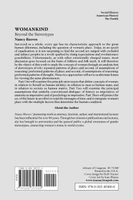
A stereotype can be defined as a rendering by consensus. Since WOMANKIND: BEYOND THE STEREOTYPES first appeared in 1971, a turbulent decade has passed. In launching a new edition after such an interval, it seems appropriate to ask how far society has moved: be-yond the stereotypes. Such motion is a critical gauge of the status of women, for the power to define can also be the power to destroy; as long as the second sex is culturally prepackaged, its biographical destiny will be preprogrammed and perilous. Looking backward then to 1971, it is clear that the liberation movement has affected consciousness; it has even subverted received doctrine. On the other hand, the stereotypes have not disappeared; they have simply gone underground. At the explicit level, one can point to new patterns; at the implicit level, traditional definitions persist, and continue to be both determinative and destructive.
Actualizing the architecture of this book, I set out to examine fixed positions related to a) stereotypes of role, and b) assumptions of thought. In this edition, I have added a section called "Interpenetrations," where I undertake to analyze, in terms of current metamorphosis, what has hap-pened in the private and in the public spheres. The chapter entitled, "Sex and Gender," deals with the characteristic interweaving of present im-peratives and past prototypes, in relation to biography. The chapter en-titled, "The Politics of Power," deals with the same characteristic inter-weaving, in relation to history. In a transitional period, transformation proceeds unevenly: old and new are a continuing part of contemporary reality. In sum, I have attempted to harmonize what is unprecedented with what is familiar, and to dissect meaningful strands from the tangle of paradoxical precepts. Embarking on such venturesome thought, I have been mindful of the caveat of Jacob Bronowski: "If today we want to find relief from the uncertainties of a changing world in some cozy arbitrary doctrine, then we had better face the likelihood that tomorrow the Dark Ages will return."
Shipping & Processing
This item is in stock with our supplier and usually ships within 3–5 business days.
Processing times
- In stock: Items marked “In Stock” are on our shelves. We pick, pack and ship them within 1–2 business days.
- In stock with our supplier: Items not marked “In Stock” are held by one of our Australian or overseas suppliers. We order them in for you and they usually dispatch within 2–5 business days (3–5 for some suppliers). The estimate next to the price is for this item.
- Special orders: Some supplier items, such as specialist and imported items, titles awaiting reprint and print-on-demand titles, take longer to arrive. If your order includes one, we’ll update you as soon as we hear from our supplier.
- Supplier delays: Occasionally a supplier is delayed, or their stock information turns out to be inaccurate. We’ll keep your order open for up to 60 days. If an item hasn’t shipped or isn’t on its way to us by then, we’ll cancel that item and refund it.
How accurate is availability?
Availability is based on the stock levels our suppliers tell us they hold, and we update it regularly. If a supplier issue affects your order, we’ll let you know with an updated estimate.
Delivery
- As soon as your order ships you’ll get an email with tracking.
- Australia Post usually delivers within 2–10 business days of shipping (around 4 in metro areas and around 6 in regional areas).
- If your order has more than one item, we hold the in-stock items until everything is ready, so we can ship your whole order together in one parcel.
- Shipping cost: Free on orders over $100 within Australia, otherwise $9.95 flat rate per order however many items you buy. Free shipping applies to Australian addresses only; delivery to New Zealand is $14.95 per order.
- Check your address: If an order goes to an incorrect address you gave us, or isn’t collected and Australia Post returns it to us, you’ll need to pay the postage to send it again.
Cancellations
Need to change or cancel an order? Contact us as soon as possible at contact@bookloop.com.au or through our contact page.
- Within 30 minutes: You can change or cancel your order for a full refund within 30 minutes of placing it.
- After 30 minutes: Your order is already being processed, so it can no longer be changed or cancelled. If we can accept a late cancellation, we may offer store credit instead of a refund.
- Items in transit: Once an item is on its way, either from our supplier to us or from us to you, it can’t be cancelled. If you no longer want it once it arrives, you can return it as a change of mind, with return postage at your cost. See Returns.
- Separate orders can’t be combined once they’ve been placed, and adding or swapping items can change the delivery estimate.
- Supplier delays: Occasionally a supplier is delayed, or their stock information turns out to be inaccurate. We’ll keep your order open for up to 60 days. If an item hasn’t shipped or isn’t on its way to us by then, we’ll cancel that item and refund it.
Faulty or damaged items are always covered. See Returns.
Returns
Damaged or incorrect items (within 30 days)
If an item arrives damaged or isn’t what you ordered, contact us within 30 days of delivery. We may ask for a photo, and if we need the item back we’ll send a prepaid return label, so it costs you nothing. You’ll receive a replacement or refund, as guaranteed under the Australian Consumer Law.
Change of mind (within 30 days)
We offer a refund or store credit for change of mind within 30 days of purchase when:
- you have your proof of purchase;
- the item is unused and in its original condition and packaging;
- it isn’t a sale item, special order, custom item or gift voucher.
You pay the postage to return change-of-mind items. Change-of-mind returns aren’t available for print-on-demand titles or bulk orders with special pricing.
Returned to sender
If an order is sent to an incorrect address you gave us, or isn’t collected and Australia Post returns it to us, you’ll need to pay the postage to send it again.