WHITEHEAD S PHILOSOPHY OF ORGANISM: PREFACE: THERE is no substitute for the first-hand study of a philosopher and if this book were to be looked on as in any way intended as a summary or epitome of Professor Whitehead s Philosophy of Organism, it had better never have been written. It represents simply an attempt on the part of one of his students to acknowledge something of her debt to his work and his wisdom and to discuss some of the ideas in it which have seemed to her of special significance. My first reason for daring to venture on this is simply my interest in and affection for Professor Whitehead and his writings. My second is the growing suspicion that there are a number of people of philosophical interests who are asking for an introduction to the study of his metaphysics, especially of Process and Reality. If this book should send any back with renewed encouragement to re-reading Professor Whitehead s own later books, that is the best outcome I should hope for from it. And here, at the outset, I must make an apology and an explanation. Throughout the greater part of his life, Professor Whitehead s own work has been in pure mathematics and although his later books have contained practically no technical mathematical reasoning, or even mathematical logic, I am continually conscious that the way in which his mind is working is essentially that of a pure mathematician. I have the uneasy suspicion that however much notions like that of Extensive Connection and the Method of Ex tensive Abstraction may seem clear, they probably connote something quite different to someone with a trained understanding of the mathematical ideas involved in them. My own knowledge of the mathematical side of Professor Whitehead s work is confined to a none too confident ac quaintance with the philosophical sections at the beginning of the Principia Mathematica and to his Introduction to Mathematics H. U. L.. From these, and from Russells books, I think I have been able to grasp something of the general ideas which form the foundations of modern mathematics, as far as to be able to distinguish between those parts of Professor Whiteheads work which call for a more specialised mathe matical knowledge on the part of the reader, and those which can be comprehensible to the ordinary person of philosophical interests, and a general idea, but no very detailed knowledge, of the foundations of mathematics. Such I take to be the situation in which a great many of us who wish to learn from Professor Whitehead find ourselves and it is as such and for such that I have written. I claim no more than to be trying to show how Professor Whitehead s philosophical work strikes a student who comes to it from a background of literary instead of scientific philosophy. If the experiment fails, and it is not for us to understand it, I can only accept the rebuke. But I have a suspicion that Professor Whitehead himself does not think of the ideas contained in what he calls his Philosophy of Organism as only to be available to a closed circle of mathe maticians and logicians. Moreover, the opinions of some of these about his Giffbrd Lectures seem to suggest that they think that his mathe matical genius is losing itself in a welter of pseudo-Platonic mysticism. It may be, therefore, that there are sides of this later work whose defence can fall to some of us whose interests in philosophy are necessarily humanist rather than mathematical. I am not saying anything against the mathematicians and mathematical logicians I envy them too deeply for that. But the ad venture of rationalism is a many-sided one, and happily its pursuit must be co-operative. I wish to thank the Commonwealth Fund of New York and the Council of Somerville College for electing me to research fellowships which have made it possible to undertake this work...
WHITEHEAD S PHILOSOPHY OF ORGANISM: PREFACE: THERE is no substitute for the first-hand study of a philosopher and if this book were to be looked on as in any way intended as a summary or epitome of Professor Whitehead s Philosophy of Organism, it had better never have been written. It represents simply an attempt on the part of one of his students to acknowledge something of her debt to his work and his wisdom and to discuss some of the ideas in it which have seemed to her of special significance. My first reason for daring to venture on this is simply my interest in and affection for Professor Whitehead and his writings. My second is the growing suspicion that there are a number of people of philosophical interests who are asking for an introduction to the study of his metaphysics, especially of Process and Reality. If this book should send any back with renewed encouragement to re-reading Professor Whitehead s own later books, that is the best outcome I should hope for from it. And here, at the outset, I must make an apology and an explanation. Throughout the greater part of his life, Professor Whitehead s own work has been in pure mathematics and although his later books have contained practically no technical mathematical reasoning, or even mathematical logic, I am continually conscious that the way in which his mind is working is essentially that of a pure mathematician. I have the uneasy suspicion that however much notions like that of Extensive Connection and the Method of Ex tensive Abstraction may seem clear, they probably connote something quite different to someone with a trained understanding of the mathematical ideas involved in them. My own knowledge of the mathematical side of Professor Whitehead s work is confined to a none too confident ac quaintance with the philosophical sections at the beginning of the Principia Mathematica and to his Introduction to Mathematics H. U. L.. From these, and from Russells books, I think I have been able to grasp something of the general ideas which form the foundations of modern mathematics, as far as to be able to distinguish between those parts of Professor Whiteheads work which call for a more specialised mathe matical knowledge on the part of the reader, and those which can be comprehensible to the ordinary person of philosophical interests, and a general idea, but no very detailed knowledge, of the foundations of mathematics. Such I take to be the situation in which a great many of us who wish to learn from Professor Whitehead find ourselves and it is as such and for such that I have written. I claim no more than to be trying to show how Professor Whitehead s philosophical work strikes a student who comes to it from a background of literary instead of scientific philosophy. If the experiment fails, and it is not for us to understand it, I can only accept the rebuke. But I have a suspicion that Professor Whitehead himself does not think of the ideas contained in what he calls his Philosophy of Organism as only to be available to a closed circle of mathe maticians and logicians. Moreover, the opinions of some of these about his Giffbrd Lectures seem to suggest that they think that his mathe matical genius is losing itself in a welter of pseudo-Platonic mysticism. It may be, therefore, that there are sides of this later work whose defence can fall to some of us whose interests in philosophy are necessarily humanist rather than mathematical. I am not saying anything against the mathematicians and mathematical logicians I envy them too deeply for that. But the ad venture of rationalism is a many-sided one, and happily its pursuit must be co-operative. I wish to thank the Commonwealth Fund of New York and the Council of Somerville College for electing me to research fellowships which have made it possible to undertake this work...
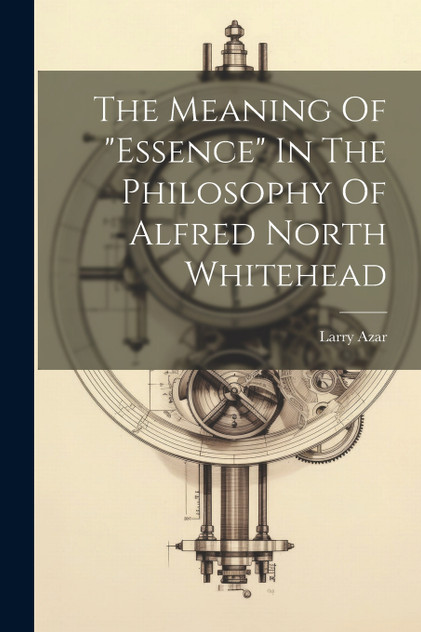
In Process and Reality and other works, Alfred North Whitehead struggled to come to terms with the impact the new science of quantum mechanics would have on metaphysics.This ambitious book is the...
Azar provides a comprehensive analysis of Whitehead's concept of essence, arguing that it is central to his philosophy of organism. Azar traces the development of Whitehead's ideas about essence...
Discover your next great read at BookLoop, Australiand online bookstore offering a vast selection of titles across various genres and interests. Whether you're curious about what's trending or searching for graphic novels that captivate, thrilling crime and mystery fiction, or exhilarating action and adventure stories, our curated collections have something for every reader. Delve into imaginative fantasy worlds or explore the realms of science fiction that challenge the boundaries of reality. Fans of contemporary narratives will find compelling stories in our contemporary fiction section. Embark on epic journeys with our fantasy and science fiction titles,
Shop Trending Books and New Releases
Explore our new releases for the most recent additions in romance books, fantasy books, graphic novels, crime and mystery books, science fiction books as well as biographies, cookbooks, self help books, tarot cards, fortunetelling and much more. With titles covering current trends, booktok and bookstagram recommendations, and emerging authors, BookLoop remains your go-to local australian bookstore for buying books online across all book genres.
Shop Best Books By Collection
Stay updated with the literary world by browsing our trending books, featuring the latest bestsellers and critically acclaimed works. Explore titles from popular brands like Minecraft, Pokemon, Star Wars, Bluey, Lonely Planet, ABIA award winners, Peppa Pig, and our specialised collection of ADHD books. At BookLoop, we are committed to providing a diverse and enriching reading experience for all.
Sign In
your cart
Your cart is empty
Menu
Search
PRE-SALES
If you have any questions before making a purchase chat with our online operators to get more information.