
Trending Bestseller

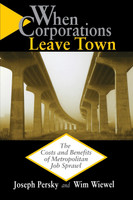
When Corporations Leave Town

The Costs and Benefits of Metropolitan Job Sprawl

No reviews yet Write a Review
Paperback / softback
01 August 2000
$38.21
Ships in 3-5 business days
Hurry up! Current stock:

New suburban communities have sprung up all over America, while industrial plants and other commercial districts in the inner city have been left to decay. Nowhere is this more evident that the midwestern United States, where newly formed communities have funneled jobs and income from the inner city. Generally known as sprawl, the problem is particularly acute in those metropolitan areas where deconcentration is taking place—decline in the central city coupled with suburban growth. This process creates benefits in the sububrs, but also increasingly poses costs in the form of congestion and increased infrastructure costs. When Corporations Leave Town analyzes and develops a consistent and comprehensive cost-benefit analysis of employment deconcentration, focussing on central cities and their suburbs.
Sprawl and deconcentration have become big issues in Vice President Albert Gore’s presidential campaign, and are the subject of a growing number of policy initiatives, conferences, and research efforts by organizing such as the Urban Land Institute, the National Homebuilders Association, and the Brookings Institute. Joseph Persky and Wim Wiewel compare the costs and benefits of a firm's locating in the central city with locating in the suburbs. They use a hypothetical model of a large manufacturing plant and a business services office in the Chicago metropolitan area to calculate tangible and intangible costs such as population and traffic congestion, air pollution, housing abandonment, loss of farmland, tax liabilities, and the strain put on suburban public resources. Persky and Wiewel then explore a broad range of public policies advocated for reversing or mitigating metropolitan deconcentration.

You Can Find This Book In

    Book Details
    ISBN-13
    9780814329085
    Author
    JOSEPH PERSKY
    Publisher
    Wayne State University Press
    Published
    01 August 2000
    Format
    Paperback / softback

    This product hasn't received any reviews yet. Be the first to review this product!

    $38.21
    Ships in 3-5 business days
    Hurry up! Current stock:

    When Corporations Leave Town

    $38.21

    Description

    New suburban communities have sprung up all over America, while industrial plants and other commercial districts in the inner city have been left to decay. Nowhere is this more evident that the midwestern United States, where newly formed communities have funneled jobs and income from the inner city. Generally known as sprawl, the problem is particularly acute in those metropolitan areas where deconcentration is taking place—decline in the central city coupled with suburban growth. This process creates benefits in the sububrs, but also increasingly poses costs in the form of congestion and increased infrastructure costs. When Corporations Leave Town analyzes and develops a consistent and comprehensive cost-benefit analysis of employment deconcentration, focussing on central cities and their suburbs.
    Sprawl and deconcentration have become big issues in Vice President Albert Gore’s presidential campaign, and are the subject of a growing number of policy initiatives, conferences, and research efforts by organizing such as the Urban Land Institute, the National Homebuilders Association, and the Brookings Institute. Joseph Persky and Wim Wiewel compare the costs and benefits of a firm's locating in the central city with locating in the suburbs. They use a hypothetical model of a large manufacturing plant and a business services office in the Chicago metropolitan area to calculate tangible and intangible costs such as population and traffic congestion, air pollution, housing abandonment, loss of farmland, tax liabilities, and the strain put on suburban public resources. Persky and Wiewel then explore a broad range of public policies advocated for reversing or mitigating metropolitan deconcentration.

    You Can Find This Book In

      This Book Is Categorised As