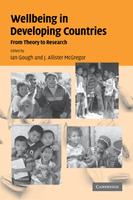
In a world where many experience unprecedented levels of wellbeing, chronic poverty remains a major concern for many developing countries and the international community. Conventional frameworks for understanding development and poverty have focused on money, commodities and economic growth. This 2007 book challenges these conventional approaches and contributes to a new paradigm for development centred on human wellbeing. Poor people are not defined solely by their poverty and a wellbeing approach provides a better means of understanding how people become and stay poor. It examines three perspectives: ideas of human functioning, capabilities and needs; the analysis of livelihoods and resource use; and research on subjective wellbeing and happiness. A range of international experts from psychology, economics, anthropology, sociology, political science and development evaluate the state-of-the-art in understanding wellbeing from these perspectives. This book establishes a new strategy and methodology for researching wellbeing that can influence policy.
This is an open access title available under the terms of a CC BY-NC-SA 3.0 IGO licence. It is free to read at Oxford Scholarship Online and offered as a free PDF download from OUP and selected open...
The Nordic countries have the world's best working life. Unlike in many other countries, global competition has not created inequality, uncertainty, long working hours, standardization and...
At the core of education, the notion of wellbeing permeates both learner and teacher wellbeing. This book explores the central role and responsibility of education in ensuring the wellbeing of...
The question of the meaning of progress and development is back on the political agenda. How to frame this discontent and search for new alternatives when either socialism or liberalism no...
In an era of social and cultural change, the development of self-awareness is critical for global change. Individuals must navigate changing societal cultures and digital transformations while...