Bachelor Thesis from the year 2012 in the subject Politics - Region: Near East, Near Orient, grade: 14,5 p., University of Marburg, language: English, abstract: Since South Sudan's secession in 2011 the Nile River is shared by eleven countries (Egypt, Sudan, South Sudan, Ethiopia, Eritrea, Tanzania, Uganda, Burundi, Rwanda, D.R. Congo, and Kenya) and is home to more than 160 million people. Five of these countries are among the poorest in the world, with low levels of socio-economic development or - in other words - with tremendously high potentials and motivation to socio-economically develop. Today, exploitation of the Nile has reached its limits with ever greater populations and industries depending on its waters. History has created political power structures which represent the exact opposite of the hydrological realites. Although the river receives no contributions from Egyptian territories, the country is the most excessive consumer of Nile waters and dependent on it for about 95% of its freshwater resources. At the same time, precipitation in the Ethiopian highlands delivers some 85% of the Nile's flow measured at Aswan. But the prevailing river regime in combination with a history of political instability has so far prevented Ethiopia and other upstream countries from constructing major schemes to facilitate economic development or even flood protection for its population.Will increasing resource competition lead the states of the Nile Basin to full-scale inter-riparian conflict? Egypt with its very limited availabilty of arable land and already over-exploited and contested water resources must consider to at least partially abandon its pursuit of food self-sufficiency and examine alternative ways of securing its population's needs.Given growing pressures on the Nile's resources, the Basin states' current order will have to fundamentally shift from the current lower-basin domination to a more integrative regional system that appreciates both the upperrip
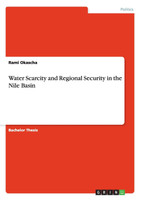
Water Scarcity and Regional Security in the Nile Basin
RRP:
$83.00
Description
Bachelor Thesis from the year 2012 in the subject Politics - Region: Near East, Near Orient, grade: 14,5 p., University of Marburg, language: English, abstract: Since South Sudan's secession in 2011 the Nile River is shared by eleven countries (Egypt, Sudan, South Sudan, Ethiopia, Eritrea, Tanzania, Uganda, Burundi, Rwanda, D.R. Congo, and Kenya) and is home to more than 160 million people. Five of these countries are among the poorest in the world, with low levels of socio-economic development or - in other words - with tremendously high potentials and motivation to socio-economically develop. Today, exploitation of the Nile has reached its limits with ever greater populations and industries depending on its waters. History has created political power structures which represent the exact opposite of the hydrological realites. Although the river receives no contributions from Egyptian territories, the country is the most excessive consumer of Nile waters and dependent on it for about 95% of its freshwater resources. At the same time, precipitation in the Ethiopian highlands delivers some 85% of the Nile's flow measured at Aswan. But the prevailing river regime in combination with a history of political instability has so far prevented Ethiopia and other upstream countries from constructing major schemes to facilitate economic development or even flood protection for its population.Will increasing resource competition lead the states of the Nile Basin to full-scale inter-riparian conflict? Egypt with its very limited availabilty of arable land and already over-exploited and contested water resources must consider to at least partially abandon its pursuit of food self-sufficiency and examine alternative ways of securing its population's needs.Given growing pressures on the Nile's resources, the Basin states' current order will have to fundamentally shift from the current lower-basin domination to a more integrative regional system that appreciates both the upperrip
The book presents a critical and comparative analysis of the hydropolitical landscape of African transboundary river basins which, for much of the past century, have been affected by water scarcity.
This book presents results of scientific studies ranging from hydrological modelling to water management and policy issues in the Nile River basin. It examines the physical, hydrometeorological and ...
This volume reviews the evolution of ten years' learning and discovery about water scarcity, livelihoods, and food security within the CGIAR Challenge Program on Water and Food. It draws on...
This work has been selected by scholars as being culturally important, and is part of the knowledge base of civilization as we know it. This work was reproduced from the original artifact, and...
Discover your next great read at BookLoop, Australiand online bookstore offering a vast selection of titles across various genres and interests. Whether you're curious about what's trending or searching for graphic novels that captivate, thrilling crime and mystery fiction, or exhilarating action and adventure stories, our curated collections have something for every reader. Delve into imaginative fantasy worlds or explore the realms of science fiction that challenge the boundaries of reality. Fans of contemporary narratives will find compelling stories in our contemporary fiction section. Embark on epic journeys with our fantasy and science fiction titles,
Shop Trending Books and New Releases
Explore our new releases for the most recent additions in romance books, fantasy books, graphic novels, crime and mystery books, science fiction books as well as biographies, cookbooks, self help books, tarot cards, fortunetelling and much more. With titles covering current trends, booktok and bookstagram recommendations, and emerging authors, BookLoop remains your go-to local australian bookstore for buying books online across all book genres.
Shop Best Books By Collection
Stay updated with the literary world by browsing our trending books, featuring the latest bestsellers and critically acclaimed works. Explore titles from popular brands like Minecraft, Pokemon, Star Wars, Bluey, Lonely Planet, ABIA award winners, Peppa Pig, and our specialised collection of ADHD books. At BookLoop, we are committed to providing a diverse and enriching reading experience for all.
Sign In
your cart
Your cart is empty
Menu
Search
PRE-SALES
If you have any questions before making a purchase chat with our online operators to get more information.