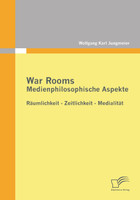
Dieses Buch zeigt die Ursprünge und historischen Weiterentwicklungen des Konzepts "War Room". Darüber hinaus erfolgt eine kritische Analyse der philosophischen Grundaspekte Medialität, Räumlichkeit und Zeitlichkeit in Bezug auf War Rooms.War Rooms waren ursprünglich Kommandozentralen für den militärischen Bereich, in erster Linie darauf ausgerichtet, Entscheidungsfindungen zu optimieren. Die Weiterentwicklungen dieser geschichtlichen Konzeption sind insofern höchst bedeutsam für die Gegenwart, da sie als Vorlagen für heutige Entscheidungszentren in Politik und Wirtschaft dienen. Trotz dieser Relevanz wurde die Thematik bisher kaum bearbeitet.Das Buch besteht aus drei Teilen: Erstens wird die historische Entwicklung der Idee des Feldherrn anhand einer vierteiligen Feldherrntypologie nachgezeichnet (genialer, technokratischer, technisch-psychologischer und informatisierter Feldherr). Zweitens werden drei bedeutsame geschichtliche Beispiele für War Rooms angeführt (Schlieffenplan, Cabinet War Rooms, White House Situations Room), die sich jeweils auf einen der drei letzten Feldherrntypen beziehen. Schließlich werden die herausgearbeiteten Feldherrnstufen hinsichtlich medienphilosophischer Aspekte analysiert. This book evaluates the origins as well as the historical advancements of the War Room conception. Additionally, a critical analysis of the War Room's philosophical aspects, mediality, spatiality, and temporality is provided. Originally, War Rooms were command centers for the military domain, primarily set up to optimise decision-making. The advancements of this historical conception are highly relevant, because they serve as role models for command centers in current politics and business. Even with this relevance, the topic of this book has hardly been covered until now.This book consists of three main parts. The first part focuses on the historical development of the idea of the commander that is based on a four-part typology; ingenious, technocratic, techn
Dieses Buch zeigt die Ursprünge und historischen Weiterentwicklungen des Konzepts "War Room". Darüber hinaus erfolgt eine kritische Analyse der philosophischen Grundaspekte Medialität, Räumlichkeit und Zeitlichkeit in Bezug auf War Rooms.War Rooms waren ursprünglich Kommandozentralen für den militärischen Bereich, in erster Linie darauf ausgerichtet, Entscheidungsfindungen zu optimieren. Die Weiterentwicklungen dieser geschichtlichen Konzeption sind insofern höchst bedeutsam für die Gegenwart, da sie als Vorlagen für heutige Entscheidungszentren in Politik und Wirtschaft dienen. Trotz dieser Relevanz wurde die Thematik bisher kaum bearbeitet.Das Buch besteht aus drei Teilen: Erstens wird die historische Entwicklung der Idee des Feldherrn anhand einer vierteiligen Feldherrntypologie nachgezeichnet (genialer, technokratischer, technisch-psychologischer und informatisierter Feldherr). Zweitens werden drei bedeutsame geschichtliche Beispiele für War Rooms angeführt (Schlieffenplan, Cabinet War Rooms, White House Situations Room), die sich jeweils auf einen der drei letzten Feldherrntypen beziehen. Schließlich werden die herausgearbeiteten Feldherrnstufen hinsichtlich medienphilosophischer Aspekte analysiert. This book evaluates the origins as well as the historical advancements of the War Room conception. Additionally, a critical analysis of the War Room's philosophical aspects, mediality, spatiality, and temporality is provided. Originally, War Rooms were command centers for the military domain, primarily set up to optimise decision-making. The advancements of this historical conception are highly relevant, because they serve as role models for command centers in current politics and business. Even with this relevance, the topic of this book has hardly been covered until now.This book consists of three main parts. The first part focuses on the historical development of the idea of the commander that is based on a four-part typology; ingenious, technocratic, techn
War room to Board room is a well-organized collection containing over 50 leadership techniques used by West Pointers who developed their leadership skills as top officers in the military and now...
The APOSTOLIC WAR ROOM is a call to each individual to fulfill their own personal life destiny without distractions, setbacks and hindrances from the enemy, Satan. Each individual can overcome the...
Discover your next great read at BookLoop, Australiand online bookstore offering a vast selection of titles across various genres and interests. Whether you're curious about what's trending or searching for graphic novels that captivate, thrilling crime and mystery fiction, or exhilarating action and adventure stories, our curated collections have something for every reader. Delve into imaginative fantasy worlds or explore the realms of science fiction that challenge the boundaries of reality. Fans of contemporary narratives will find compelling stories in our contemporary fiction section. Embark on epic journeys with our fantasy and science fiction titles,
Shop Trending Books and New Releases
Explore our new releases for the most recent additions in romance books, fantasy books, graphic novels, crime and mystery books, science fiction books as well as biographies, cookbooks, self help books, tarot cards, fortunetelling and much more. With titles covering current trends, booktok and bookstagram recommendations, and emerging authors, BookLoop remains your go-to local australian bookstore for buying books online across all book genres.
Shop Best Books By Collection
Stay updated with the literary world by browsing our trending books, featuring the latest bestsellers and critically acclaimed works. Explore titles from popular brands like Minecraft, Pokemon, Star Wars, Bluey, Lonely Planet, ABIA award winners, Peppa Pig, and our specialised collection of ADHD books. At BookLoop, we are committed to providing a diverse and enriching reading experience for all.
Sign In
your cart
Your cart is empty
Menu
Search
PRE-SALES
If you have any questions before making a purchase chat with our online operators to get more information.