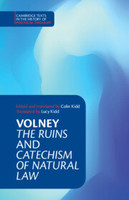
Volney: 'The Ruins' and 'Catechism of Natural Law'
Volney was once as influential as Tom Paine, and the author of one of the most popular works of the French Revolutionary era. The Ruins of Empires makes an argument for popular sovereignty, couched in the alluring and accessible form of an Oriental dream-tale. A favourite of both Thomas Jefferson, who translated it, and the young Abraham Lincoln, the Ruins advances a scheme of radical, utopian politics premised upon the deconstruction of all the world's religions. It was widely celebrated by radicals in Britain and America, and exercised an enormous influence on poets from Percy Bysshe Shelley to Walt Whitman for its indictments of tyranny and priestcraft. Volney instead advocates a return to natural precepts shorn of superstition, set out in his sequel, the Catechism of Natural Law. These days Volney enjoys a high profile in African-American Studies as a proponent of Black Egyptianism.
This work has been selected by scholars as being culturally important, and is part of the knowledge base of civilization as we know it.This work is in the "public domain in the United States of...
This groundbreaking work by Johann Gaspar Spurzheim explores the natural laws governing human behavior and the ways in which they can be harnessed for personal growth and self-improvement. Spurzheim...
This is a reproduction of a book published before 1923. This book may have occasional imperfections such as missing or blurred pages, poor pictures, errant marks,...
This work has been selected by scholars as being culturally important and is part of the knowledge base of civilization as we know it.This work is in the public domain in the United States of...
This book considers the problem of ecological degradation from the perspective of a Christian clergyman and hunter. Drawing on the tradition of Christian mysticism, the author offers a series of...