Trending Bestseller

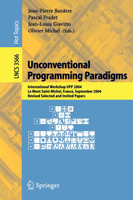
Unconventional Programming Paradigms

International Workshop UPP 2004, Le Mont Saint Michel, France, September 15-17, 2004, Revised Selected and Invited Papers

Jean-Pierre Banâtre

No reviews yet Write a Review
Paperback / softback
15 July 2005
$92.00
Ships in 5–7 business days
Hurry up! Current stock:
Nowadays, developers have to face the proliferation of hardware and software environments, the increasing demands of the users, the growing number of p- grams and the sharing of information, competences and services thanks to the generalization ofdatabasesandcommunication networks. Aprogramisnomore a monolithic entity conceived, produced and ?nalized before being used. A p- gram is now seen as an open and adaptive frame, which, for example, can - namically incorporate services not foreseen by the initial designer. These new needs call for new control structures and program interactions. Unconventionalapproachestoprogramminghavelongbeendevelopedinv- iousnichesandconstituteareservoirofalternativewaystofacetheprogramming languages crisis. New models of programming (e. g. , bio-inspired computing, - ti?cialchemistry,amorphouscomputing,. . . )arealsocurrentlyexperiencinga renewed period of growth as they face speci?c needs and new application - mains. These approaches provide new abstractions and notations or develop new ways of interacting with programs. They are implemented by embedding new sophisticated data structures in a classical programming model (API), by extending an existing language with new constructs (to handle concurrency, - ceptions, open environments, . . . ), by conceiving new software life cycles and program executions (aspect weaving, run-time compilation) or by relying on an entire new paradigm to specify a computation. They are inspired by theoretical considerations (e. g. , topological, algebraic or logical foundations), driven by the domain at hand (domain-speci?c languages like PostScript, musical notation, animation, signal processing, etc. ) or by metaphors taken from various areas (quantum computing, computing with molecules, information processing in - ological tissues, problem solving from nature, ethological and social modeling).

This product hasn't received any reviews yet. Be the first to review this product!

$92.00
Ships in 5–7 business days
Hurry up! Current stock:

Unconventional Programming Paradigms

$92.00

Description

Nowadays, developers have to face the proliferation of hardware and software environments, the increasing demands of the users, the growing number of p- grams and the sharing of information, competences and services thanks to the generalization ofdatabasesandcommunication networks. Aprogramisnomore a monolithic entity conceived, produced and ?nalized before being used. A p- gram is now seen as an open and adaptive frame, which, for example, can - namically incorporate services not foreseen by the initial designer. These new needs call for new control structures and program interactions. Unconventionalapproachestoprogramminghavelongbeendevelopedinv- iousnichesandconstituteareservoirofalternativewaystofacetheprogramming languages crisis. New models of programming (e. g. , bio-inspired computing, - ti?cialchemistry,amorphouscomputing,. . . )arealsocurrentlyexperiencinga renewed period of growth as they face speci?c needs and new application - mains. These approaches provide new abstractions and notations or develop new ways of interacting with programs. They are implemented by embedding new sophisticated data structures in a classical programming model (API), by extending an existing language with new constructs (to handle concurrency, - ceptions, open environments, . . . ), by conceiving new software life cycles and program executions (aspect weaving, run-time compilation) or by relying on an entire new paradigm to specify a computation. They are inspired by theoretical considerations (e. g. , topological, algebraic or logical foundations), driven by the domain at hand (domain-speci?c languages like PostScript, musical notation, animation, signal processing, etc. ) or by metaphors taken from various areas (quantum computing, computing with molecules, information processing in - ological tissues, problem solving from nature, ethological and social modeling).

Customers Also Viewed

Buy Books Online at BookLoop

Discover your next great read at BookLoop, Australiand online bookstore offering a vast selection of titles across various genres and interests. Whether you're curious about what's trending or searching for graphic novels that captivate, thrilling crime and mystery fiction, or exhilarating action and adventure stories, our curated collections have something for every reader. Delve into imaginative fantasy worlds or explore the realms of science fiction that challenge the boundaries of reality. Fans of contemporary narratives will find compelling stories in our contemporary fiction section. Embark on epic journeys with our fantasy and science fiction titles,

Shop Trending Books and New Releases

Explore our new releases for the most recent additions in romance books, fantasy books, graphic novels, crime and mystery books, science fiction books as well as biographies, cookbooks, self help books, tarot cards, fortunetelling and much more. With titles covering current trends, booktok and bookstagram recommendations, and emerging authors, BookLoop remains your go-to local australian bookstore for buying books online across all book genres.

Shop Best Books By Collection

Stay updated with the literary world by browsing our trending books, featuring the latest bestsellers and critically acclaimed works. Explore titles from popular brands like Minecraft, Pokemon, Star Wars, Bluey, Lonely Planet, ABIA award winners, Peppa Pig, and our specialised collection of ADHD books. At BookLoop, we are committed to providing a diverse and enriching reading experience for all.