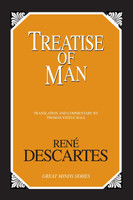
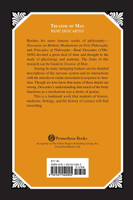
Besides his more famous works of philosophy - Discourse on Method, Meditations on First Philosophy, and Principles of Philosophy - Descartes devoted a great deal of time and thought to the study of physiology and anatomy. An account of his activities in 1629 reports that he visited butcher shops on an almost daily basis to study specific animal organs, and he practiced dissection and even vivisection to explore the workings of major organ systems. In the 1630s, he assisted in the dissection of human cadavers - all to satisfy his intense curiosity about how bodies, animal and human, work. The fruits of this research can be found in his Treatise of Man, a work that he decided not to publish for fear of suffering the same fate as Galileo. Consequently, this fascinating treatise did not appear until twelve years after his death.Among its many intriguing features are his detailed descriptions of the nervous system and its interactions with the muscles to create movement in response to stimulus. Though we now know that many of these details are wrong, Descartes' understanding that much of the body functions as a machine was a stroke of genius. He is the first to describe the reflex arc, anticipating Pavlov and the behaviorists by almost 300 years. The idea of the body as a kind of animal machine that functions according to physical laws was an immense advance over the previous scholastic notions based on Aristotle, which merely begged the question of how the various organs of the body work by stating that it is in their nature to perform their specific functions.This is a landmark work that students of history, medicine, biology, and the history of science will find richly rewarding.
Besides his more famous works of philosophy - Discourse on Method, Meditations on First Philosophy, and Principles of Philosophy - Descartes devoted a great deal of time and thought to the study of physiology and anatomy. An account of his activities in 1629 reports that he visited butcher shops on an almost daily basis to study specific animal organs, and he practiced dissection and even vivisection to explore the workings of major organ systems. In the 1630s, he assisted in the dissection of human cadavers - all to satisfy his intense curiosity about how bodies, animal and human, work. The fruits of this research can be found in his Treatise of Man, a work that he decided not to publish for fear of suffering the same fate as Galileo. Consequently, this fascinating treatise did not appear until twelve years after his death.Among its many intriguing features are his detailed descriptions of the nervous system and its interactions with the muscles to create movement in response to stimulus. Though we now know that many of these details are wrong, Descartes' understanding that much of the body functions as a machine was a stroke of genius. He is the first to describe the reflex arc, anticipating Pavlov and the behaviorists by almost 300 years. The idea of the body as a kind of animal machine that functions according to physical laws was an immense advance over the previous scholastic notions based on Aristotle, which merely begged the question of how the various organs of the body work by stating that it is in their nature to perform their specific functions.This is a landmark work that students of history, medicine, biology, and the history of science will find richly rewarding.
This work has been selected by scholars as being culturally important, and is part of the knowledge base of civilization as we know it.This work is in the "public domain in the United States of...
Three treatises by twelfth-century Cistercians, who reflect on the human person as the image of God and capax Dei, capable of God, of being reformed to the divine Image. Of the three-Isaac of Stella,...
"It was Christ who said, "Thou art Peter and upon this rock I shall build My Church." However, He is seldom able to remain in His Church anymore. We have now seen Christ exiled from His Church except...
The 18th century was a wealth of knowledge, exploration and rapidly growing technology and expanding record-keeping made possible by advances in the printing press. In its determination to preserve...
Discover your next great read at BookLoop, Australiand online bookstore offering a vast selection of titles across various genres and interests. Whether you're curious about what's trending or searching for graphic novels that captivate, thrilling crime and mystery fiction, or exhilarating action and adventure stories, our curated collections have something for every reader. Delve into imaginative fantasy worlds or explore the realms of science fiction that challenge the boundaries of reality. Fans of contemporary narratives will find compelling stories in our contemporary fiction section. Embark on epic journeys with our fantasy and science fiction titles,
Shop Trending Books and New Releases
Explore our new releases for the most recent additions in romance books, fantasy books, graphic novels, crime and mystery books, science fiction books as well as biographies, cookbooks, self help books, tarot cards, fortunetelling and much more. With titles covering current trends, booktok and bookstagram recommendations, and emerging authors, BookLoop remains your go-to local australian bookstore for buying books online across all book genres.
Shop Best Books By Collection
Stay updated with the literary world by browsing our trending books, featuring the latest bestsellers and critically acclaimed works. Explore titles from popular brands like Minecraft, Pokemon, Star Wars, Bluey, Lonely Planet, ABIA award winners, Peppa Pig, and our specialised collection of ADHD books. At BookLoop, we are committed to providing a diverse and enriching reading experience for all.
Sign In
your cart
Your cart is empty
Menu
Search
PRE-SALES
If you have any questions before making a purchase chat with our online operators to get more information.