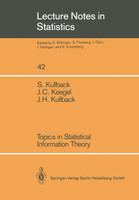
The relevance of information theory to statistical theory and its applications to stochastic processes is a unifying influence in these TOPICS. The integral representation of discrimination information is presented in these TOPICS reviewing various approaches used in the literature, and is also developed herein using intrinsically information-theoretic methods. Log likelihood ratios associated with various stochastic processes are computed by an application of minimum discrimination information estimates. Linear discriminant functionals are used in the information-theoretic analysis of a variety of stochastic processes. Sections are numbered serially within each chapter, with a decimal notation for subsections. Equations, examples, theorems and lemmas, are numbered serially within each section with a decimal notation. The digits to the left of the decimal point represent the section and the digits to the right of the decimal point the serial number within the section. When reference is made to a section, equation, example, theorem or lemma within the same chapter only the section number or equation number, etc., is given. When the reference is to a section ,equation, etc., in a different chapter, then in addition to the section or equation etc., number, the chapter number is also given. References to the bibliography are by the author's name followed by the year of publication in parentheses. The transpose of a matrix is denoted by a prime; thus one-row matrices are denoted by primes as the transposes of one-column matrices (vectors).
The relevance of information theory to statistical theory and its applications to stochastic processes is a unifying influence in these TOPICS. The integral representation of discrimination information is presented in these TOPICS reviewing various approaches used in the literature, and is also developed herein using intrinsically information-theoretic methods. Log likelihood ratios associated with various stochastic processes are computed by an application of minimum discrimination information estimates. Linear discriminant functionals are used in the information-theoretic analysis of a variety of stochastic processes. Sections are numbered serially within each chapter, with a decimal notation for subsections. Equations, examples, theorems and lemmas, are numbered serially within each section with a decimal notation. The digits to the left of the decimal point represent the section and the digits to the right of the decimal point the serial number within the section. When reference is made to a section, equation, example, theorem or lemma within the same chapter only the section number or equation number, etc., is given. When the reference is to a section ,equation, etc., in a different chapter, then in addition to the section or equation etc., number, the chapter number is also given. References to the bibliography are by the author's name followed by the year of publication in parentheses. The transpose of a matrix is denoted by a prime; thus one-row matrices are denoted by primes as the transposes of one-column matrices (vectors).
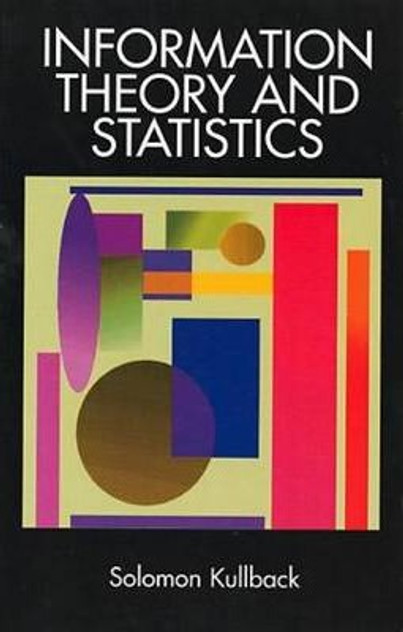
Highly useful text studies logarithmic measures of information and their application to testing statistical hypotheses. Includes numerous worked examples and problems. References. Glossary. Appendix.
Topics in Multi-User Information Theory presents a review of eleven of the fundamental issues in multi-user information theory. Each chapter is devoted to one particular issue and follows the same...
"Information Theory and Statistical Learning" presents theoretical and practical results about information theoretic methods used in the context of statistical learning. The book will ...
The Fourth Purdue Symposium on Statistical Decision Theory and Related Topics was held at Purdue University during the period June 15-20, 1986. The symposium brought together many prominent leaders...
Discover your next great read at BookLoop, Australiand online bookstore offering a vast selection of titles across various genres and interests. Whether you're curious about what's trending or searching for graphic novels that captivate, thrilling crime and mystery fiction, or exhilarating action and adventure stories, our curated collections have something for every reader. Delve into imaginative fantasy worlds or explore the realms of science fiction that challenge the boundaries of reality. Fans of contemporary narratives will find compelling stories in our contemporary fiction section. Embark on epic journeys with our fantasy and science fiction titles,
Shop Trending Books and New Releases
Explore our new releases for the most recent additions in romance books, fantasy books, graphic novels, crime and mystery books, science fiction books as well as biographies, cookbooks, self help books, tarot cards, fortunetelling and much more. With titles covering current trends, booktok and bookstagram recommendations, and emerging authors, BookLoop remains your go-to local australian bookstore for buying books online across all book genres.
Shop Best Books By Collection
Stay updated with the literary world by browsing our trending books, featuring the latest bestsellers and critically acclaimed works. Explore titles from popular brands like Minecraft, Pokemon, Star Wars, Bluey, Lonely Planet, ABIA award winners, Peppa Pig, and our specialised collection of ADHD books. At BookLoop, we are committed to providing a diverse and enriching reading experience for all.
Sign In
your cart
Your cart is empty
Menu
Search
PRE-SALES
If you have any questions before making a purchase chat with our online operators to get more information.