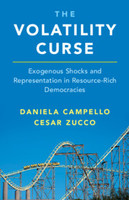
The Volatility Curse examines the conditions under which economic voting can (and cannot) function as a mechanism of democratic accountability, challenging existing theories that are largely based on experiences in developed democracies. Drawing on cross-national data from around the world and micro-level evidence from Latin America, Daniela Campello and Cesar Zucco make two broad, related arguments. First, they show that economic voting is pervasive around the world, but in economically volatile developing democracies that are dependent on commodity exports and inflows of foreign capital, economic outcomes are highly contingent on conditions beyond government control, which nonetheless determine relevant political outcomes like elections, popular support, and government transitions. Second, politicians are aware of these misattribution patterns and are often able to anticipate their electoral prospects well before elections. This reduces incumbents' incentives to maximize voter welfare, as anticipated by economic voting theories, and increases the likelihood of shirking, waste, and corruption.
The world was desperate. Since the empire had fallen a hundred years ago, Gwin and her people had nearly given up hope that the Renewer would come. Gwin had lost everything. Her husband was killed in...
Any expressed wish that some form of adversity or misfortune will befall or attach to one or more persons, place, or object is called a curse! Also called an imprecation, malediction, execration,...