


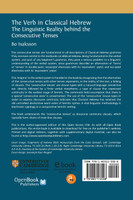
The consecutive tenses are fundamental in all descriptions of Classical Hebrew grammar. They are even basic to the textbooks on Biblical Hebrew. Being fundamental in the verbal system, and part of any beginner's grammar, they pose a serious problem to a linguistic understanding of the verbal system, since grammars describe an alternation of 'forms' or 'tenses' in double pairs: wayyiqṭol alternates with its 'equivalent' qaṭal, and wə-qaṭal alternates with its 'equivalent' yiqṭol.
This 'enigma' in the verbal system is handled in the book by recognising that the alternation of the consecutive tenses with other tenses, in the reality of the text, represents a linking of clauses. The 'consecutive tenses' are clause-types with a natural language connective wa- directly followed by a finite verbal morpheme, a type of clause that expressed continuity in the earliest stage of Semitic. The commonly held assumption that there is a special 'consecutive waw' is unwarranted. The use of the 'consecutive' clause-types in order to express discourse continuity indicates that Classical Hebrew has retained the old unmarked declarative word order of Semitic syntax. Seen in the light of recent research on the Tiberian reading tradition, the 'consecutive' wayyiqṭol can be analysed as a retention of the old Semitic past perfective *wa-yaqtul, which was pronounced wa-yiqṭol in Classical Hebrew. The 'consecutive' wə-qāṭal (pronounced wa-qaṭal in the classical language) constitutes the result of an internal Hebrew development into a construction (in the sense of Joan Bybee) already foreshadowed in the earliest Northwest Semitic languages.
The book understands the 'consecutive tenses' as discourse continuity clauses, which typically form chains of main line clauses. Such chains can be interrupted by other types of clauses. This interruption is a clause linking that receives special attention in the interpretation of the Classical Hebrew verbal system. Chapter six presents a regenerated text linguistics founded on the new terminology. A clause linking approach is the central methodological procedure in this book. To this must be added diachronic typology in a comparative Semitic setting. The linguistic examples of clause linking are gathered from a large Classical Hebrew corpus, the Pentateuch and the Book of Judges, and made searchable in a database of 6559 non-archaic text records.


Discover your next great read at BookLoop, Australiand online bookstore offering a vast selection of titles across various genres and interests. Whether you're curious about what's trending or searching for graphic novels that captivate, thrilling crime and mystery fiction, or exhilarating action and adventure stories, our curated collections have something for every reader. Delve into imaginative fantasy worlds or explore the realms of science fiction that challenge the boundaries of reality. Fans of contemporary narratives will find compelling stories in our contemporary fiction section. Embark on epic journeys with our fantasy and science fiction titles,
Explore our new releases for the most recent additions in romance books, fantasy books, graphic novels, crime and mystery books, science fiction books as well as biographies, cookbooks, self help books, tarot cards, fortunetelling and much more. With titles covering current trends, booktok and bookstagram recommendations, and emerging authors, BookLoop remains your go-to local australian bookstore for buying books online across all book genres.
Stay updated with the literary world by browsing our trending books, featuring the latest bestsellers and critically acclaimed works. Explore titles from popular brands like Minecraft, Pokemon, Star Wars, Bluey, Lonely Planet, ABIA award winners, Peppa Pig, and our specialised collection of ADHD books. At BookLoop, we are committed to providing a diverse and enriching reading experience for all.
If you have any questions before making a purchase chat with our online operators to get more information.
or find our Questions & Answers