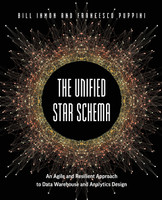
Master the most agile and resilient design for building analytics applications: the Unified Star Schema (USS) approach. The USS has many benefits over traditional dimensional modeling. Witness the power of the USS as a single star schema that serves as a foundation for all present and future business requirements of your organization.
Data warehouse legend Bill Inmon and business intelligence innovator, Francesco Puppini, explain step-by-step why the Unified Star Schema is the recommended approach for business intelligence designs today, and show through many examples how to build and use this new solution.
This book contains two parts. Part I, Architecture, explains the benefits of data marts and data warehouses, covering how organizations progressed to their current state of analytics, and to the challenges that result from current business intelligence architectures. Chapter 1 covers the drivers behind and the characteristics of the data warehouse and data mart. Chapter 2 introduces dimensional modeling concepts, including fact tables, dimensions, star joins, and snowflakes. Chapter 3 recalls the evolution of the data mart. Chapter 4 explains Extract, Transform, and Load (ETL), and the value ETL brings to reporting. Chapter 5 explores the Integrated Data Mart Approach, and Chapter 6 explains how to monitor this environment. Chapter 7 describes the different types of metadata within the data warehouse environment. Chapter 8 progresses through the evolution to our current modern data warehouse environment.
Part II, the Unified Star Schema, covers the Unified Star Schema (USS) approach and how it solves the challenges introduced in Part I. There are eight chapters within Part II:
Chapter 9, Introduction to the Unified Star Schema: Learn about its architecture and use cases, as well as how the USS approach differs from the traditional approach.
Chapter 10, Loss of Data: Learn about the loss of data and the USS Bridge. Understand that the USS approach does not create any join, and for this reason, it has no loss of data.
Chapter 11, The Fan Trap: Get introduced to the Oriented Data Model convention, and learn the dangers of a fan trap through an example. Differentiate join and association, and realize that an "in-memory association" is the preferred solution to the fan trap.
Chapter 12, The Chasm Trap: Become familiar with the Cartesian product, and then follow along with an example based on LinkedIn, which illustrates that a chasm trap produces unwanted duplicates. See that the USS Bridge is based on a union, which does not create any duplicates.
Chapter 13, Multi-Fact Queries: Distinguish between multiple facts "with direct connection" versus multiple facts "with no direct connection". Explore how BI tools are capable of building aggregated virtual rows.
Chapter 14, Loops: Learn more about loops and five traditional techniques to solve them. Follow along with an implementation, which will illustrate the solution based on the USS approach.
Chapter 15, Non-Conformed Granularities: Learn about non-conformed granularities, and learn that the Unified Star Schema introduces a solution called "re-normalization".
Chapter 16, Northwind Case Study. Witness how easy it is to detect the pitfalls of Northwind using the ODM convention. Follow along with an implementation of the USS approach on the Northwind database with various BI tools.
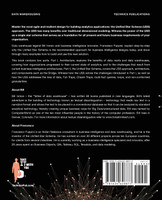
Master the most agile and resilient design for building analytics applications: the Unified Star Schema (USS) approach. The USS has many benefits over traditional dimensional modeling. Witness the power of the USS as a single star schema that serves as a foundation for all present and future business requirements of your organization.
Data warehouse legend Bill Inmon and business intelligence innovator, Francesco Puppini, explain step-by-step why the Unified Star Schema is the recommended approach for business intelligence designs today, and show through many examples how to build and use this new solution.
This book contains two parts. Part I, Architecture, explains the benefits of data marts and data warehouses, covering how organizations progressed to their current state of analytics, and to the challenges that result from current business intelligence architectures. Chapter 1 covers the drivers behind and the characteristics of the data warehouse and data mart. Chapter 2 introduces dimensional modeling concepts, including fact tables, dimensions, star joins, and snowflakes. Chapter 3 recalls the evolution of the data mart. Chapter 4 explains Extract, Transform, and Load (ETL), and the value ETL brings to reporting. Chapter 5 explores the Integrated Data Mart Approach, and Chapter 6 explains how to monitor this environment. Chapter 7 describes the different types of metadata within the data warehouse environment. Chapter 8 progresses through the evolution to our current modern data warehouse environment.
Part II, the Unified Star Schema, covers the Unified Star Schema (USS) approach and how it solves the challenges introduced in Part I. There are eight chapters within Part II:
Chapter 9, Introduction to the Unified Star Schema: Learn about its architecture and use cases, as well as how the USS approach differs from the traditional approach.
Chapter 10, Loss of Data: Learn about the loss of data and the USS Bridge. Understand that the USS approach does not create any join, and for this reason, it has no loss of data.
Chapter 11, The Fan Trap: Get introduced to the Oriented Data Model convention, and learn the dangers of a fan trap through an example. Differentiate join and association, and realize that an "in-memory association" is the preferred solution to the fan trap.
Chapter 12, The Chasm Trap: Become familiar with the Cartesian product, and then follow along with an example based on LinkedIn, which illustrates that a chasm trap produces unwanted duplicates. See that the USS Bridge is based on a union, which does not create any duplicates.
Chapter 13, Multi-Fact Queries: Distinguish between multiple facts "with direct connection" versus multiple facts "with no direct connection". Explore how BI tools are capable of building aggregated virtual rows.
Chapter 14, Loops: Learn more about loops and five traditional techniques to solve them. Follow along with an implementation, which will illustrate the solution based on the USS approach.
Chapter 15, Non-Conformed Granularities: Learn about non-conformed granularities, and learn that the Unified Star Schema introduces a solution called "re-normalization".
Chapter 16, Northwind Case Study. Witness how easy it is to detect the pitfalls of Northwind using the ODM convention. Follow along with an implementation of the USS approach on the Northwind database with various BI tools.
This adaptable guide invites kaiako to rethink approaches to engaging tamariki, re-envisage the teacher/learner dynamic, revise old habits, and reconfigure learning environments to acknowledge and...
Schema Coaching is an informative guide for coaches, providing readers with a powerful and evidence-based approach to dealing with persistent personal difficulties.
Designed to meet the formidable challenges of treating personality disorders and other complex difficulties, schema therapy combines proven cognitive-behavioral techniques with elements of other...
Discover your next great read at BookLoop, Australiand online bookstore offering a vast selection of titles across various genres and interests. Whether you're curious about what's trending or searching for graphic novels that captivate, thrilling crime and mystery fiction, or exhilarating action and adventure stories, our curated collections have something for every reader. Delve into imaginative fantasy worlds or explore the realms of science fiction that challenge the boundaries of reality. Fans of contemporary narratives will find compelling stories in our contemporary fiction section. Embark on epic journeys with our fantasy and science fiction titles,
Shop Trending Books and New Releases
Explore our new releases for the most recent additions in romance books, fantasy books, graphic novels, crime and mystery books, science fiction books as well as biographies, cookbooks, self help books, tarot cards, fortunetelling and much more. With titles covering current trends, booktok and bookstagram recommendations, and emerging authors, BookLoop remains your go-to local australian bookstore for buying books online across all book genres.
Shop Best Books By Collection
Stay updated with the literary world by browsing our trending books, featuring the latest bestsellers and critically acclaimed works. Explore titles from popular brands like Minecraft, Pokemon, Star Wars, Bluey, Lonely Planet, ABIA award winners, Peppa Pig, and our specialised collection of ADHD books. At BookLoop, we are committed to providing a diverse and enriching reading experience for all.
Sign In
your cart
Your cart is empty
Menu
Search
PRE-SALES
If you have any questions before making a purchase chat with our online operators to get more information.