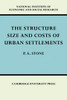
The Structure, Size and Costs of Urban Settlements
This 1973 book contains the results of a research project carried out at the National Institute between 1966 and 1969 on the economics of urban form. The effects of size, shape and form on costs of construction are examined for various model settlements. The populations of these models, and hence the facilities requires, are built up from a study of actual towns, existing and planned. Transport systems are examined, as well as the extra costs and advantages of expanding an existing settlement rather than developing on a virgin site. The financing of development and efficient use of resources is also touched upon. Finally, the discussion is placed in a nationwide context by consideration of the possible effects of development on existing towns and cities, whose viability could be endangered by a cumulative decline in their population and economic activity.
The U.S. Government Accountability Office (GAO) is an independent agency that works for Congress. The GAO watches over Congress, and investigates how the federal government spends taxpayers dollars...
Climate change and urbanization are two of the greatest challenges facing humanity in the 21st century, and their effects are converging in dangerous ways. Cities contribute significantly to global...
Recent turbulence in the financial markets has highlighted the need for diversified portfolios with lower correlations between the different investments. Life settlements meet this need, offering...