



Trending Bestseller
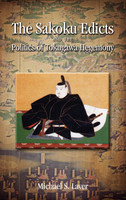
The Sakoku Edicts and the Politics of Tokugawa Hegemony
Michael S. Laver
No reviews yet
Write a Review

Write a Reviews
The Sakoku Edicts and the Politics of Tokugawa Hegemony
Hardback
18 January 2011
$185.00
Ships in 5–7 business days
The Sakoku Edicts and the Politics of Tokugawa Hegemony
$185.00
Description
In the major literature on early modern Japan, the sakoku (closed country) edicts lurk in the background, and while scholars are generally aware of the major tenets of the policy, for example, the inability of Japanese to travel abroad or the clampdown on Christianity, the specifics of the edicts have yet to be studied in detail despite its potential to reveal much about this era of Japan's history. This work seeks to clarify the seventeen-article sakoku edicts of 1635 as well as to situate the edicts in the general foreign policy of seventeenth-century Edo Japan. This book will also examine a number of other policies that evolved in the first half of the seventeenth century to complete what is commonly (and somewhat erroneously) referred to as the "closed-country period." A great number of works on European and Chinese interactions with Japan have appeared over the past few decades, and most of them have done a fine job of dispensing with the myth that Japan was somehow hermetically sealed from the outside world. Scholars are aware that the Dutch played a large role in keeping the shogun informed about affairs in Europe, and that the Chinese were coming to Japan in ever greater numbers. They are also aware of the relationship between Japan and Korea. However, the fact remains that the Tokugawa did take pains to regulate the interactions of Europeans with Japan, and these measures are generally found in the various edicts passed by the bakufu in the first half of the seventeenth century. This book translates and illuminates the specific machinery of Japan's foreign relations, especially as it pertained to European trade and Christianity. In so doing, this study will situate the edicts--which are largely taken for granted, even though little has been studied--in Japan's early modern history. There are two insights this book presents. First of all, the study will demonstrate that the sakoku edicts were not a monolithic piece of legislation, but rather they evolved over time. The edicts against Christianity, the expulsion of the Spanish and the Portuguese, and the establishment of the machinery to regulate foreign trade were all responses to historical stimuli, and as such evolved in response to Japan's interactions with Europe and European trade and ideas. Second, this work will show that, ironically, the Tokugawa control of Japan's foreign policy was meant to strengthen its domestic control, especially vis-à-vis the powerful daimyo of western Japan, who traditionally profited with relations with the West. Therefore, there is much more to the sakoku edicts than simply the regulation of Japan's relations with foreigners. This book will appeal to the wider academic community working on pre-modern and early modern Japan. It will also be of value to those whose work involves the expansion of Europe into Asia, as well as European-Asian interactions. Written in a highly accessible style, this book will be of interest to even the casual reader of Japanese history.
You May Like


The Edict
Spain 1492: Queen Isabella and King Ferdinand issue the Edict of Expulsion, requiring all Jews to leave Spain or suffer torment and death. Shock waves surge through the Jewish community. Two young...
$44.00


The Sacred Edict
This work has been selected by scholars as being culturally important, and is part of the knowledge base of civilization as we know it. This work was reproduced from the original artifact, and...
$39.00


The Mind's Edict
This plethora of poems intends to challenge one's spiritual, conceptual and ideologic beliefs, might I add, not to destroy or compete against said mentioned beliefs but more-so add a point of...
$29.00
Customers Also Viewed
Buy Books Online at BookLoop
Discover your next great read at BookLoop, Australiand online bookstore offering a vast selection of titles across various genres and interests. Whether you're curious about what's trending or searching for graphic novels that captivate, thrilling crime and mystery fiction, or exhilarating action and adventure stories, our curated collections have something for every reader. Delve into imaginative fantasy worlds or explore the realms of science fiction that challenge the boundaries of reality. Fans of contemporary narratives will find compelling stories in our contemporary fiction section. Embark on epic journeys with our fantasy and science fiction titles,
Shop Trending Books and New Releases
Explore our new releases for the most recent additions in romance books, fantasy books, graphic novels, crime and mystery books, science fiction books as well as biographies, cookbooks, self help books, tarot cards, fortunetelling and much more. With titles covering current trends, booktok and bookstagram recommendations, and emerging authors, BookLoop remains your go-to local australian bookstore for buying books online across all book genres.
Shop Best Books By Collection
Stay updated with the literary world by browsing our trending books, featuring the latest bestsellers and critically acclaimed works. Explore titles from popular brands like Minecraft, Pokemon, Star Wars, Bluey, Lonely Planet, ABIA award winners, Peppa Pig, and our specialised collection of ADHD books. At BookLoop, we are committed to providing a diverse and enriching reading experience for all.