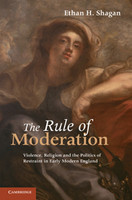
Why was it that whenever the Tudor-Stuart regime most loudly trumpeted its moderation, that regime was at its most vicious? This groundbreaking book argues that the ideal of moderation, so central to English history and identity, functioned as a tool of social, religious and political power. Thus The Rule of Moderation rewrites the history of early modern England, showing that many of its key developments - the via media of Anglicanism, political liberty, the development of empire and even religious toleration - were defined and defended as instances of coercive moderation, producing the 'middle way' through the forcible restraint of apparently dangerous excesses in Church, state and society. By showing that the quintessentially English quality of moderation was at heart an ideology of control, Ethan Shagan illuminates the subtle violence of English history and explains how, paradoxically, England came to represent reason, civility and moderation to a world it slowly conquered.
The chaotic events leading up to Mitt Romney's defeat in the 2012 election indicated how far the Republican Party had rocketed rightward away from the center of public opinion. Republicans in...
This work has been selected by scholars as being culturally important, and is part of the knowledge base of civilization as we know it. This work was reproduced from the original artifact, and...
This work has been selected by scholars as being culturally important, and is part of the knowledge base of civilization as we know it.This work is in the "public domain in the United States of...
The 18th century was a wealth of knowledge, exploration and rapidly growing technology and expanding record-keeping made possible by advances in the printing press. In its determination to preserve...