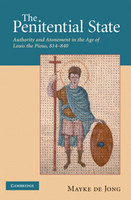
In 833 emperor Louis the Pious, Charlemagne's son, submitted to a public penance in the wake of a rebellion by his three elder sons. This penance amounted to a deposition, for Louis was to atone for his sins for the rest of his life. However, only half a year later, he was back on the throne again. In this evaluation of Louis' reign, Mayke de Jong argues that his penance was the outcome of a political discourse and practice in which the accountability of the Frankish ruler to God played an increasingly central role. However heated their debates, this was a moral high ground Louis shared with churchmen and secular magnates. Through a profound re-reading of texts by contemporary authors who reflected on legitimate authority in times of crisis, this book reveals a world in which political crime was defined as sin, and royal authority was enhanced by atonement.
Despite its title, this work by Theodore of Tarsus has more to do with the inter-workings of the Anglo-Saxon Church in the 7th century than it does with any notion of sacramental penance. Theodore is...
The 18th century was a wealth of knowledge, exploration and rapidly growing technology and expanding record-keeping made possible by advances in the printing press. In its determination to preserve...
O Lord! Make My Heart a Fountain of Contrition! As Moses struck rock in the desert with his staff to bring forth springs of water, so may God melt our hard hearts with His merciful love and give us...
Penitential Tears: Or A Cry From The Dust is a book written by Leonard Withington and originally published in 1845. The book is a collection of religious poems and essays that focus on the theme of...
This work has been selected by scholars as being culturally important, and is part of the knowledge base of civilization as we know it. This work was reproduced from the original artifact, and...