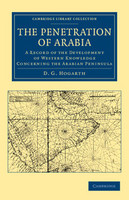
The archaeologist D. G. Hogarth (1862-1927) was, when he died, keeper of the Ashmolean Museum and president of the Royal Geographical Society. During the First World War he was acting director of the Arab Bureau in Cairo, where he was instrumental in launching the Arab Revolt, in which T. E. Lawrence, a protégé of his, played so prominent a part. This book, published in 1904 as the Hejaz railway was being built, is a summary of earlier explorations in the Arabian peninsula, by both Muslim and European travellers. Hogarth's first visit to Arabia was not made until 1916, when he travelled to Jeddah with £10,000 in gold to finance the revolt; this book is instead based on his extensive reading of travel literature, included in a bibliography for each chapter. It is thus interesting for its historiographical analysis as well as a background to Hogarth's subsequent political involvement with the region.
This work has been selected by scholars as being culturally important, and is part of the knowledge base of civilization as we know it.This work is in the "public domain in the United States of...
It's 1761. The Danish government has selected five researchers to travel to Arabia Felix, or "Happy Arabia." But the journey isn't as happy as its destination.The members all kind of hate each other,...
Various unique facts and oddities observed by the author during his employment in Saudi Arabia by Aramco (Arabian American Oil Company) in 1954 are presented, and these are contrasted to changes...
'Of all his generation's travellers, Jonathan Raban is the most sophisticated, writing with a subtle and imaginative brilliance.' Colin Thubron'One of the most humane and visionary of all travel...