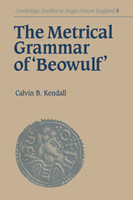
This book argues that the formal art of the Old English epic Beowulf is shaped and determined by the poetic language which the poet inherited from the traditional, oral culture of Anglo-Saxon England. The patterns of metre and alliteration exhibited in the poem were not imposed by the poet on his language, but were part of the language which he spoke, the rules of which constituted his metrical grammar. Professor Kendall investigates the constraints of syntax, metre and alliteration which govern the formal art of Beowulf. He shows how the half-lines of the poem, which are the basic units of composition, are marked by the metrical grammar for placement in the verse clause; he also establishes conditions for the presence or absence of alliteration, which enable him to say whether in any given instance the alliterative device is a mandatory function of the rules of the metrical grammar or an option exercised by the poet. Professor Kendall alters traditional views of metre; he concludes the book with a complete index of scansion according to the rules he has established.
This is a modern English translation of the epic poem Beowulf, originally composed in Old English. It tells the story of a heroic warrior named Beowulf who battles monsters and dragons to protect his...
This work has been selected by scholars as being culturally important, and is part of the knowledge base of civilization as we know it. This work was reproduced from the original artifact, and...
Any translation is a reading. Chris McCully reads Beowulf as an epic written in English using all the complex metrical conventions of its time, as well as distinctive epic tropes including...
This is a reproduction of a book published before 1923. This book may have occasional imperfections such as missing or blurred pages, poor pictures, errant marks,...