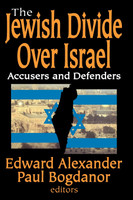
Before 1967, Israel had the overwhelming support of world opinion. So long as Israel's existence was in harmony with politically correct assumptions, it was supported, or at least accepted, by the majority of "progressive" Jews, especially in the wake of the Holocaust. This is no longer the case. The Jewish Divide Over Israel explains the role played by prominent Jews in turning Israel into an isolated pariah nation.After their catastrophic defeat in 1967, Arabs overcame inferiority on the battlefield with superiority in the war of ideas. Their propaganda stopped trumpeting their desire to eradicate Israel. Instead, in a calculated appeal to liberals and radicals, they redefined their war of aggression against the Jews as a struggle for the liberation of Palestinian Arabs. The tenacity of Arabs' rejection of Israel and their relentless campaign--in schools, universities, churches, professional organizations, and, above all, the news media--to destroy Israel's moral image had the desired impact. Many Jewish liberals became desperate to escape from the shadow of Israel's alleged misdeeds and found a way to do so by joining other members of the left in blaming Israeli sins for Arab violence. Today, Jewish liberals rationalize violence against the innocent as resistance to the oppressor, excuse Arab extremism as the frustration of a wronged party, and redefine eliminationist rhetoric and physical assaults on Jews as "criticism of Israeli policy." Israel's Jewish accusers have played a crucial and disproportionate role in the current upsurge of antisemitism precisely because they speak as Jews.The essays in this book seek to understand and throw back the assault on Israel led by such Jewish liberals and radicals as Tony Judt, Noam Chomsky, George Steiner, Daniel Boyarin, Marc Ellis, Israel Shahak, and many others. Its writers demonstrate that the foundation of the state of Israel, far from being the primal sin alleged by its accusers, was one of the few redeeming events in a century of blood and shame.
Before 1967, Israel had the overwhelming support of world opinion. So long as Israel's existence was in harmony with politically correct assumptions, it was supported, or at least accepted, by the majority of "progressive" Jews, especially in the wake of the Holocaust. This is no longer the case. The Jewish Divide Over Israel explains the role played by prominent Jews in turning Israel into an isolated pariah nation.After their catastrophic defeat in 1967, Arabs overcame inferiority on the battlefield with superiority in the war of ideas. Their propaganda stopped trumpeting their desire to eradicate Israel. Instead, in a calculated appeal to liberals and radicals, they redefined their war of aggression against the Jews as a struggle for the liberation of Palestinian Arabs. The tenacity of Arabs' rejection of Israel and their relentless campaign--in schools, universities, churches, professional organizations, and, above all, the news media--to destroy Israel's moral image had the desired impact. Many Jewish liberals became desperate to escape from the shadow of Israel's alleged misdeeds and found a way to do so by joining other members of the left in blaming Israeli sins for Arab violence. Today, Jewish liberals rationalize violence against the innocent as resistance to the oppressor, excuse Arab extremism as the frustration of a wronged party, and redefine eliminationist rhetoric and physical assaults on Jews as "criticism of Israeli policy." Israel's Jewish accusers have played a crucial and disproportionate role in the current upsurge of antisemitism precisely because they speak as Jews.The essays in this book seek to understand and throw back the assault on Israel led by such Jewish liberals and radicals as Tony Judt, Noam Chomsky, George Steiner, Daniel Boyarin, Marc Ellis, Israel Shahak, and many others. Its writers demonstrate that the foundation of the state of Israel, far from being the primal sin alleged by its accusers, was one of the few redeeming events in a century of blood and shame.
In this controversial work, acclaimed Israeli writer and human rights campaigner Israel Shahak, and American scholar Norton Mezvinsky, examine the history and consequences of Jewish fundamentalism in...
This is a reproduction of a book published before 1923. This book may have occasional imperfections such as missing or blurred pages, poor pictures, errant marks,...
Discover your next great read at BookLoop, Australiand online bookstore offering a vast selection of titles across various genres and interests. Whether you're curious about what's trending or searching for graphic novels that captivate, thrilling crime and mystery fiction, or exhilarating action and adventure stories, our curated collections have something for every reader. Delve into imaginative fantasy worlds or explore the realms of science fiction that challenge the boundaries of reality. Fans of contemporary narratives will find compelling stories in our contemporary fiction section. Embark on epic journeys with our fantasy and science fiction titles,
Shop Trending Books and New Releases
Explore our new releases for the most recent additions in romance books, fantasy books, graphic novels, crime and mystery books, science fiction books as well as biographies, cookbooks, self help books, tarot cards, fortunetelling and much more. With titles covering current trends, booktok and bookstagram recommendations, and emerging authors, BookLoop remains your go-to local australian bookstore for buying books online across all book genres.
Shop Best Books By Collection
Stay updated with the literary world by browsing our trending books, featuring the latest bestsellers and critically acclaimed works. Explore titles from popular brands like Minecraft, Pokemon, Star Wars, Bluey, Lonely Planet, ABIA award winners, Peppa Pig, and our specialised collection of ADHD books. At BookLoop, we are committed to providing a diverse and enriching reading experience for all.
Sign In
your cart
Your cart is empty
Menu
Search
PRE-SALES
If you have any questions before making a purchase chat with our online operators to get more information.