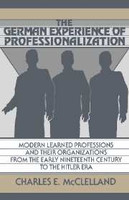
Modern learned professions (medicine, law, teaching, engineering, and others) developed in central Europe just as vigorously as in England or America. Yet their close relationship with state power - more typical of the world development of professions than the Anglo-American model - led to a different historical experience of professionalization. This work is the first to explore that experience in a comprehensive way from the time when modern learned professions arose until the eve of World War II. Based on the history and surviving records of German professional organizations, it shows how the learned professions emerged gradually in the nineteenth century from the shadow of strong state regulation to achieve a high degree of autonomy and control over professional standards by the First World War. By studying professional groups collectively, it gives a more contoured picture of their fate under National Socialism than works dedicated primarily to the phenomenon of fascism itself.
This work has been selected by scholars as being culturally important, and is part of the knowledge base of civilization as we know it. This work was reproduced from the original artifact, and...
This book offers a unique perspective on the experiences of German Methodist preachers in the United States in the late 19th century. Through personal accounts, readers will gain insights into the...
This work has been selected by scholars as being culturally important, and is part of the knowledge base of civilization as we know it.This work is in the "public domain in the United States of...