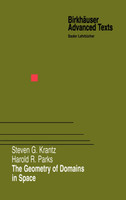
The analysis of Euclidean space is well-developed. The classical Lie groups that act naturally on Euclidean space-the rotations, dilations, and trans lations-have both shaped and guided this development. In particular, the Fourier transform and the theory of translation invariant operators (convolution transforms) have played a central role in this analysis. Much modern work in analysis takes place on a domain in space. In this context the tools, perforce, must be different. No longer can we expect there to be symmetries. Correspondingly, there is no longer any natural way to apply the Fourier transform. Pseudodifferential operators and Fourier integral operators can playa role in solving some of the problems, but other problems require new, more geometric, ideas. At a more basic level, the analysis of a smoothly bounded domain in space requires a great deal of preliminary spadework. Tubular neighbor hoods, the second fundamental form, the notion of "positive reach", and the implicit function theorem are just some of the tools that need to be invoked regularly to set up this analysis. The normal and tangent bundles become part of the language of classical analysis when that analysis is done on a domain. Many of the ideas in partial differential equations-such as Egorov's canonical transformation theorem-become rather natural when viewed in geometric language. Many of the questions that are natural to an analyst-such as extension theorems for various classes of functions-are most naturally formulated using ideas from geometry.
The analysis of Euclidean space is well-developed. The classical Lie groups that act naturally on Euclidean space-the rotations, dilations, and trans lations-have both shaped and guided this development. In particular, the Fourier transform and the theory of translation invariant operators (convolution transforms) have played a central role in this analysis. Much modern work in analysis takes place on a domain in space. In this context the tools, perforce, must be different. No longer can we expect there to be symmetries. Correspondingly, there is no longer any natural way to apply the Fourier transform. Pseudodifferential operators and Fourier integral operators can playa role in solving some of the problems, but other problems require new, more geometric, ideas. At a more basic level, the analysis of a smoothly bounded domain in space requires a great deal of preliminary spadework. Tubular neighbor hoods, the second fundamental form, the notion of "positive reach", and the implicit function theorem are just some of the tools that need to be invoked regularly to set up this analysis. The normal and tangent bundles become part of the language of classical analysis when that analysis is done on a domain. Many of the ideas in partial differential equations-such as Egorov's canonical transformation theorem-become rather natural when viewed in geometric language. Many of the questions that are natural to an analyst-such as extension theorems for various classes of functions-are most naturally formulated using ideas from geometry.
This work examines a rich tapestry of themes and concepts and provides a comprehensive treatment of an important area of mathematics, while simultaneously covering a broader area of the geometry of...
Driven by numerous examples from the complex geometric viewpoint New results presented for the first time Widely accessible, with all necessary background material provided...
This work has been selected by scholars as being culturally important, and is part of the knowledge base of civilization as we know it.This work is in the "public domain in the United States of...
A number of important topics in complex analysis and geometry are covered in this excellent introductory text. Written by experts in the subject, each chapter unfolds from the basics to the more...
Discover your next great read at BookLoop, Australiand online bookstore offering a vast selection of titles across various genres and interests. Whether you're curious about what's trending or searching for graphic novels that captivate, thrilling crime and mystery fiction, or exhilarating action and adventure stories, our curated collections have something for every reader. Delve into imaginative fantasy worlds or explore the realms of science fiction that challenge the boundaries of reality. Fans of contemporary narratives will find compelling stories in our contemporary fiction section. Embark on epic journeys with our fantasy and science fiction titles,
Shop Trending Books and New Releases
Explore our new releases for the most recent additions in romance books, fantasy books, graphic novels, crime and mystery books, science fiction books as well as biographies, cookbooks, self help books, tarot cards, fortunetelling and much more. With titles covering current trends, booktok and bookstagram recommendations, and emerging authors, BookLoop remains your go-to local australian bookstore for buying books online across all book genres.
Shop Best Books By Collection
Stay updated with the literary world by browsing our trending books, featuring the latest bestsellers and critically acclaimed works. Explore titles from popular brands like Minecraft, Pokemon, Star Wars, Bluey, Lonely Planet, ABIA award winners, Peppa Pig, and our specialised collection of ADHD books. At BookLoop, we are committed to providing a diverse and enriching reading experience for all.
Sign In
your cart
Your cart is empty
Menu
Search
PRE-SALES
If you have any questions before making a purchase chat with our online operators to get more information.