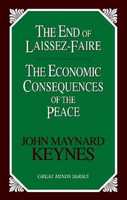
John Maynard Keynes (1883-1946) was the most influential economist of the first half of the twentieth century. During both world wars he was an adviser to the British treasury, and his theory of government stimulation of the economy through deficit spending influenced Franklin D. Roosevelt's "New Deal" administration. The mass unemployment caused by the Great Depression inspired his most famous work, General Theory of Employment, Interest and Money (1935-36). Keynes first gained widespread prominence immediately following World War I, when he attended the Versailles peace conference as an economic adviser to British Prime Minister David Lloyd George. Disgusted with the harshly punitive and unrealistic provisions of the Versailles Treaty, as well as the political chicanery and general incompetence of the chief participants, he published The Economic Consequences of the Peace in 1919. This book gained a good deal of notoriety because of its withering portraits of both French premier Georges Clemenceau and U.S. President Woodrow Wilson. Keynes described Clemenceau as motivated only by shortsighted nationalistic goals and vindictiveness, which aimed at crippling Germany for generations no matter what the consequences to the rest of Europe. He found fault with Wilson for his ivory tower idealism, lack of diplomatic savvy, and unfamiliarity with the political realities of Europe. This ineffectual combination ultimately dashed his best hopes for a League of Nations and a just resolution to the war in Europe. In a point-by-point analysis Keynes makes clear the ruinous consequences of the treaty to all of Europe and proposes substantial modifications. Unfortunately, few appreciated Keynes's prescience, and he saw his worst fears realized in the rise of Hitler and the devastation of World War II. In The End of Laissez-Faire (1926) he presents a brief historical review of laissez-faire economic policy. Though he agrees in principle that a marketplace of free individuals pursuing their own self-interest without government interference has a better chance of improving society's economic situation than socialist alternatives, he suggests that government can play a constructive role in protecting individuals from the worst harms of capitalism's cycles, especially as concerns unemployment. Other useful government functions are the dissemination of information relating to business conditions, encouraging savings and investment along "nationally productive channels," and forming a national policy about the size of population. Keynes's brilliant mind and lucid writing are evident on every page. Both of these works are still well worth reading for his many stimulating ideas and profound knowledge of economics.
John Maynard Keynes (1883-1946) was the most influential economist of the first half of the twentieth century. During both world wars he was an adviser to the British treasury, and his theory of government stimulation of the economy through deficit spending influenced Franklin D. Roosevelt's "New Deal" administration. The mass unemployment caused by the Great Depression inspired his most famous work, General Theory of Employment, Interest and Money (1935-36). Keynes first gained widespread prominence immediately following World War I, when he attended the Versailles peace conference as an economic adviser to British Prime Minister David Lloyd George. Disgusted with the harshly punitive and unrealistic provisions of the Versailles Treaty, as well as the political chicanery and general incompetence of the chief participants, he published The Economic Consequences of the Peace in 1919. This book gained a good deal of notoriety because of its withering portraits of both French premier Georges Clemenceau and U.S. President Woodrow Wilson. Keynes described Clemenceau as motivated only by shortsighted nationalistic goals and vindictiveness, which aimed at crippling Germany for generations no matter what the consequences to the rest of Europe. He found fault with Wilson for his ivory tower idealism, lack of diplomatic savvy, and unfamiliarity with the political realities of Europe. This ineffectual combination ultimately dashed his best hopes for a League of Nations and a just resolution to the war in Europe. In a point-by-point analysis Keynes makes clear the ruinous consequences of the treaty to all of Europe and proposes substantial modifications. Unfortunately, few appreciated Keynes's prescience, and he saw his worst fears realized in the rise of Hitler and the devastation of World War II. In The End of Laissez-Faire (1926) he presents a brief historical review of laissez-faire economic policy. Though he agrees in principle that a marketplace of free individuals pursuing their own self-interest without government interference has a better chance of improving society's economic situation than socialist alternatives, he suggests that government can play a constructive role in protecting individuals from the worst harms of capitalism's cycles, especially as concerns unemployment. Other useful government functions are the dissemination of information relating to business conditions, encouraging savings and investment along "nationally productive channels," and forming a national policy about the size of population. Keynes's brilliant mind and lucid writing are evident on every page. Both of these works are still well worth reading for his many stimulating ideas and profound knowledge of economics.
Here is a book that explores what American economic policy should and can be--a superb yet controversial interpretation of the relation between domestic economic health and international politics,...
The Making of the Modern Law: Legal Treatises, 1800-1926 includes over 20,000 analytical, theoretical and practical works on American and British Law. It includes the writings of major legal...
In THE END OF LAISSEZ-FAIRE, Keynes presents a brief historical review of laissez-faire economic policy. Though he agrees in principle that the marketplace should be free of government interference,...
20 essays drawn from numerous online archives that illuminate two decades' progress of DeVoon's thought on the philosophy of laissez faire law, a system that he believes has no direct antecedents,...
This is the first full length study of Boisguilbert's work to appear in English. It contains an extended discussion of the context in which Boisguilbert worked, as well as a detailed analysis of his...
Discover your next great read at BookLoop, Australiand online bookstore offering a vast selection of titles across various genres and interests. Whether you're curious about what's trending or searching for graphic novels that captivate, thrilling crime and mystery fiction, or exhilarating action and adventure stories, our curated collections have something for every reader. Delve into imaginative fantasy worlds or explore the realms of science fiction that challenge the boundaries of reality. Fans of contemporary narratives will find compelling stories in our contemporary fiction section. Embark on epic journeys with our fantasy and science fiction titles,
Shop Trending Books and New Releases
Explore our new releases for the most recent additions in romance books, fantasy books, graphic novels, crime and mystery books, science fiction books as well as biographies, cookbooks, self help books, tarot cards, fortunetelling and much more. With titles covering current trends, booktok and bookstagram recommendations, and emerging authors, BookLoop remains your go-to local australian bookstore for buying books online across all book genres.
Shop Best Books By Collection
Stay updated with the literary world by browsing our trending books, featuring the latest bestsellers and critically acclaimed works. Explore titles from popular brands like Minecraft, Pokemon, Star Wars, Bluey, Lonely Planet, ABIA award winners, Peppa Pig, and our specialised collection of ADHD books. At BookLoop, we are committed to providing a diverse and enriching reading experience for all.
Sign In
your cart
Your cart is empty
Menu
Search
PRE-SALES
If you have any questions before making a purchase chat with our online operators to get more information.