
Trending Bestseller

The Autocratic Academy

No reviews yet Write a Review
Hardback
352 Pages
$198.35
Ships in 3-5 business days
Hurry up! Current stock:
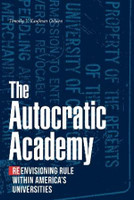
Critics of contemporary US higher education often point to the academy's "corporatization" as one of its defining maladies. However, in The Autocratic Academy Timothy V. Kaufman-Osborn argues that American colleges and universities have always been organized as corporations in which the power to rule is legally vested in and monopolized by antidemocratic governing boards. This institutional form, Kaufman-Osborn contends, is antithetical to the free inquiry that defines the purpose of higher education. Tracing the history of the American academy from the founding of Harvard (1636), through the Supreme Court's Dartmouth v. Woodward ruling (1819), and into the twenty-first century, Kaufman-Osborn shows how the university's autocratic legal constitution is now yoked to its representation on the model of private property. Explaining why appeals to the cause of shared governance cannot succeed in wresting power from the academy's autocrats, Kaufman-Osborn argues that American universities must now be reincorporated in accordance with the principles of democratic republicanism. Only then can the academy's members hold accountable those chosen to govern and collectively determine the disposition of higher education's unique public goods.
Book Details
ISBN-13
9781478017127
Author
Timothy V. Kaufman-Osborn
Format
Hardback
Pages
352

This product hasn't received any reviews yet. Be the first to review this product!

$198.35
Ships in 3-5 business days
Hurry up! Current stock:

The Autocratic Academy

$198.35

Description

Critics of contemporary US higher education often point to the academy's "corporatization" as one of its defining maladies. However, in The Autocratic Academy Timothy V. Kaufman-Osborn argues that American colleges and universities have always been organized as corporations in which the power to rule is legally vested in and monopolized by antidemocratic governing boards. This institutional form, Kaufman-Osborn contends, is antithetical to the free inquiry that defines the purpose of higher education. Tracing the history of the American academy from the founding of Harvard (1636), through the Supreme Court's Dartmouth v. Woodward ruling (1819), and into the twenty-first century, Kaufman-Osborn shows how the university's autocratic legal constitution is now yoked to its representation on the model of private property. Explaining why appeals to the cause of shared governance cannot succeed in wresting power from the academy's autocrats, Kaufman-Osborn argues that American universities must now be reincorporated in accordance with the principles of democratic republicanism. Only then can the academy's members hold accountable those chosen to govern and collectively determine the disposition of higher education's unique public goods.