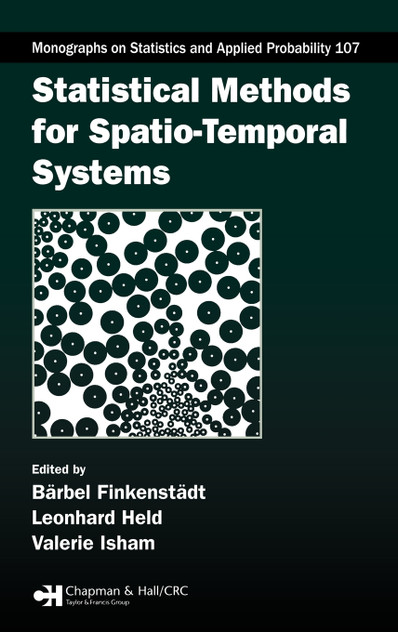
In the spatial or spatio-temporal context, specifying the correct covariance function is fundamental to obtain efficient predictions, and to understand the underlying physical process of interest. This book focuses on covariance and variogram functions, their role in prediction, and appropriate choice of these functions in applications. Both recent and more established methods are illustrated to assess many common assumptions on these functions, such as, isotropy, separability, symmetry, and intrinsic correlation.
After an extensive introduction to spatial methodology, the book details the effects of common covariance assumptions and addresses methods to assess the appropriateness of such assumptions for various data structures.
Key features:
An extensive introduction to spatial methodology including a survey of spatial covariance functions and their use in spatial prediction (kriging) is given.
Explores methodology for assessing the appropriateness of assumptions on covariance functions in the spatial, spatio-temporal, multivariate spatial, and point pattern settings.
Provides illustrations of all methods based on data and simulation experiments to demonstrate all methodology and guide to proper usage of all methods.
Presents a brief survey of spatial and spatio-temporal models, highlighting the Gaussian case and the binary data setting, along with the different methodologies for estimation and model fitting for these two data structures.
Discusses models that allow for anisotropic and nonseparable behaviour in covariance functions in the spatial, spatio-temporal and multivariate settings.
Gives an introduction to point pattern models, including testing for randomness, and fitting regular and clustered point patterns. The importance and assessment of isotropy of point patterns is detailed.
Statisticians, researchers, and data analysts working with spatial and space-time data will benefit from this book as well as will graduate students with a background in basic statistics following courses in engineering, quantitative ecology or atmospheric science.
In the spatial or spatio-temporal context, specifying the correct covariance function is fundamental to obtain efficient predictions, and to understand the underlying physical process of interest. This book focuses on covariance and variogram functions, their role in prediction, and appropriate choice of these functions in applications. Both recent and more established methods are illustrated to assess many common assumptions on these functions, such as, isotropy, separability, symmetry, and intrinsic correlation.
After an extensive introduction to spatial methodology, the book details the effects of common covariance assumptions and addresses methods to assess the appropriateness of such assumptions for various data structures.
Key features:
An extensive introduction to spatial methodology including a survey of spatial covariance functions and their use in spatial prediction (kriging) is given.
Explores methodology for assessing the appropriateness of assumptions on covariance functions in the spatial, spatio-temporal, multivariate spatial, and point pattern settings.
Provides illustrations of all methods based on data and simulation experiments to demonstrate all methodology and guide to proper usage of all methods.
Presents a brief survey of spatial and spatio-temporal models, highlighting the Gaussian case and the binary data setting, along with the different methodologies for estimation and model fitting for these two data structures.
Discusses models that allow for anisotropic and nonseparable behaviour in covariance functions in the spatial, spatio-temporal and multivariate settings.
Gives an introduction to point pattern models, including testing for randomness, and fitting regular and clustered point patterns. The importance and assessment of isotropy of point patterns is detailed.
Statisticians, researchers, and data analysts working with spatial and space-time data will benefit from this book as well as will graduate students with a background in basic statistics following courses in engineering, quantitative ecology or atmospheric science.
Statistical Methods for Spatial and Spatio-Temporal Data Analysis provides a complete range of spatio-temporal covariance functions and discusses ways of constructing them. This book is a unified...
Discover your next great read at BookLoop, Australiand online bookstore offering a vast selection of titles across various genres and interests. Whether you're curious about what's trending or searching for graphic novels that captivate, thrilling crime and mystery fiction, or exhilarating action and adventure stories, our curated collections have something for every reader. Delve into imaginative fantasy worlds or explore the realms of science fiction that challenge the boundaries of reality. Fans of contemporary narratives will find compelling stories in our contemporary fiction section. Embark on epic journeys with our fantasy and science fiction titles,
Shop Trending Books and New Releases
Explore our new releases for the most recent additions in romance books, fantasy books, graphic novels, crime and mystery books, science fiction books as well as biographies, cookbooks, self help books, tarot cards, fortunetelling and much more. With titles covering current trends, booktok and bookstagram recommendations, and emerging authors, BookLoop remains your go-to local australian bookstore for buying books online across all book genres.
Shop Best Books By Collection
Stay updated with the literary world by browsing our trending books, featuring the latest bestsellers and critically acclaimed works. Explore titles from popular brands like Minecraft, Pokemon, Star Wars, Bluey, Lonely Planet, ABIA award winners, Peppa Pig, and our specialised collection of ADHD books. At BookLoop, we are committed to providing a diverse and enriching reading experience for all.
Sign In
your cart
Your cart is empty
Menu
Search
PRE-SALES
If you have any questions before making a purchase chat with our online operators to get more information.