Trending Bestseller

Signifying Woman

Linda Zerilli

No reviews yet Write a Review
Paperback / softback
232 Pages
$100.00
Ships in 3-5 business days
Hurry up! Current stock:
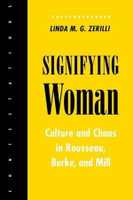
Woman has been defined in classic political theory as elusive yet dangerous, by her nature fundamentally destructive to public life. In the view of Linda M. G. Zerilli, however, gender relations shape the very grammar of citizenship. In deeply textured interpretations of Rousseau, Burke, and Mill, Zerilli recasts our understanding of woman as the agent of social chaos and makes a major advance for feminist political theory.
Zerilli draws on the work of Julia Kristeva to help explain woman's traditionally ambiguous position, as a frontier figure neither inside nor outside political space. She discusses Rousseau, Burke, and Mill (as representatives of republican, conservative, and liberal thought) and traces how each author uses woman rhetorically as he sets forth a distinct political vision in response to the social conflicts of his time. These writers invoke "woman" to articulate not only the disruptive forces of sexuality but also those of class conflict and its resolution. Menacing the stability of meaning itself, woman symbolizes the looming social, economic, and political forces of civilization (for Rousseau), of revolution (for Burke), of capitalism (for Mill) - that threaten conventional distinctions of gender and class.

This product hasn't received any reviews yet. Be the first to review this product!

$100.00
Ships in 3-5 business days
Hurry up! Current stock:

Signifying Woman

$100.00

Description

Woman has been defined in classic political theory as elusive yet dangerous, by her nature fundamentally destructive to public life. In the view of Linda M. G. Zerilli, however, gender relations shape the very grammar of citizenship. In deeply textured interpretations of Rousseau, Burke, and Mill, Zerilli recasts our understanding of woman as the agent of social chaos and makes a major advance for feminist political theory.
Zerilli draws on the work of Julia Kristeva to help explain woman's traditionally ambiguous position, as a frontier figure neither inside nor outside political space. She discusses Rousseau, Burke, and Mill (as representatives of republican, conservative, and liberal thought) and traces how each author uses woman rhetorically as he sets forth a distinct political vision in response to the social conflicts of his time. These writers invoke "woman" to articulate not only the disruptive forces of sexuality but also those of class conflict and its resolution. Menacing the stability of meaning itself, woman symbolizes the looming social, economic, and political forces of civilization (for Rousseau), of revolution (for Burke), of capitalism (for Mill) - that threaten conventional distinctions of gender and class.
Customers Also Viewed