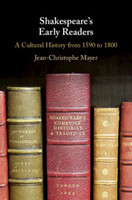
Who were Shakespeare's first readers and what did they think of his works? Offering the first dedicated account of the ways in which Shakespeare's texts were read in the centuries during which they were originally produced, Jean-Christophe Mayer reconsiders the role of readers in the history of Shakespeare's rise to fame and in the history of canon formation. Addressing an essential formative 'moment' when Shakespeare became a literary dramatist, this book explores six crucial fields: literacy; reading and life-writing; editing Shakespeare's text; marking Shakespeare for the theatre; commonplacing; and passing judgement. Through close examination of rare material, some of which has never been published before, and covering both the marks left by readers in their books and early manuscript extracts of Shakespeare, Mayer demonstrates how the worlds of print and performance overlapped at a time when Shakespeare offered a communal text, the ownership of which was essentially undecided.
This book offers a unique approach to reading Shakespeare's plays by condensing them for easier understanding. It provides an overview of the most important themes and characters in each play, and...
This work has been selected by scholars as being culturally important, and is part of the knowledge base of civilization as we know it. This work was reproduced from the original artifact, and...
This is a reproduction of a book published before 1923. This book may have occasional imperfections such as missing or blurred pages, poor pictures, errant marks, etc. that were either part of the...
The Shakespeare And Milton Reader is a collection of scenes and extracts from the works of two literary giants, William Shakespeare and John Milton. Published in 1883, this book features an array of...