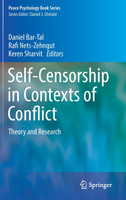
This groundbreaking volume explores the concept of self-censorship as it relates to individuals and societies and functions as a barrier to peace. Defining self-censorship as the act of intentionally and voluntarily withholding information from others in the absence of formal obstacles, the volumes introduces self-censorship as one of the socio-psychological mechanisms that prevent the free flow of information and thus obstruct proper functioning of democratic societies. Moreover it analyzes this socio-psychological phenomenon specifically in the context of intractable conflict, providing much evidence from the Israeli-Palestinian conflict. Moving from the micro to the macro level, the collected chapters put the individual as the focal unit of psychological analysis while embedding the individual in multiple levels of context including families, organizations, and societies. Following a firm conceptual explanation of self-censorship, a selection of both emerging and prominent scholars describe the ways in which self-censorship factors into families, organizations, education, academia, and other settings. Further chapters discuss self-censorship in military contexts, narratives of political violence, and the media. Finally, the volume concludes by looking at the ways in which harmful self-censorship in societies can be overcome, and explores the future of self-censorship research. In doing so, this volume solidifies self-censorship as an important phenomenon of social behavior with major individual and collective consequences, while stimulating exciting and significant new research possibilities in the social and behavioral sciences. Conceptually carving out a new area in peace psychology, Self Censorship in Contexts of Peace and Conflict will appeal to psychologists, sociologists, peace researchers, political scientists, practitioners, and all those with a wish to understand the personal and societal functioning of individuals in the real world.
This groundbreaking volume explores the concept of self-censorship as it relates to individuals and societies and functions as a barrier to peace. Defining self-censorship as the act of intentionally and voluntarily withholding information from others in the absence of formal obstacles, the volumes introduces self-censorship as one of the socio-psychological mechanisms that prevent the free flow of information and thus obstruct proper functioning of democratic societies. Moreover it analyzes this socio-psychological phenomenon specifically in the context of intractable conflict, providing much evidence from the Israeli-Palestinian conflict. Moving from the micro to the macro level, the collected chapters put the individual as the focal unit of psychological analysis while embedding the individual in multiple levels of context including families, organizations, and societies. Following a firm conceptual explanation of self-censorship, a selection of both emerging and prominent scholars describe the ways in which self-censorship factors into families, organizations, education, academia, and other settings. Further chapters discuss self-censorship in military contexts, narratives of political violence, and the media. Finally, the volume concludes by looking at the ways in which harmful self-censorship in societies can be overcome, and explores the future of self-censorship research. In doing so, this volume solidifies self-censorship as an important phenomenon of social behavior with major individual and collective consequences, while stimulating exciting and significant new research possibilities in the social and behavioral sciences. Conceptually carving out a new area in peace psychology, Self Censorship in Contexts of Peace and Conflict will appeal to psychologists, sociologists, peace researchers, political scientists, practitioners, and all those with a wish to understand the personal and societal functioning of individuals in the real world.
This book studies how technological solutions can be used to alleviate the current state of legal systems, with their clogged up courtrooms and inefficient conflict resolution methods. It reviews the...
Complexity and interculturalism characterize the worldwide societies. Though for many aspects these multiple forms convey a positive meaning, from other points of view a problematic communication...
Discover your next great read at BookLoop, Australiand online bookstore offering a vast selection of titles across various genres and interests. Whether you're curious about what's trending or searching for graphic novels that captivate, thrilling crime and mystery fiction, or exhilarating action and adventure stories, our curated collections have something for every reader. Delve into imaginative fantasy worlds or explore the realms of science fiction that challenge the boundaries of reality. Fans of contemporary narratives will find compelling stories in our contemporary fiction section. Embark on epic journeys with our fantasy and science fiction titles,
Shop Trending Books and New Releases
Explore our new releases for the most recent additions in romance books, fantasy books, graphic novels, crime and mystery books, science fiction books as well as biographies, cookbooks, self help books, tarot cards, fortunetelling and much more. With titles covering current trends, booktok and bookstagram recommendations, and emerging authors, BookLoop remains your go-to local australian bookstore for buying books online across all book genres.
Shop Best Books By Collection
Stay updated with the literary world by browsing our trending books, featuring the latest bestsellers and critically acclaimed works. Explore titles from popular brands like Minecraft, Pokemon, Star Wars, Bluey, Lonely Planet, ABIA award winners, Peppa Pig, and our specialised collection of ADHD books. At BookLoop, we are committed to providing a diverse and enriching reading experience for all.
Sign In
your cart
Your cart is empty
Menu
Search
PRE-SALES
If you have any questions before making a purchase chat with our online operators to get more information.