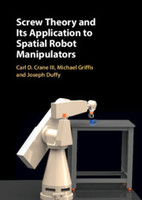
Screw Theory and its Application to Spatial Robot Manipulators
Discover a fresh take on classical screw theory and understand the geometry embedded within robots and mechanisms with this essential text. The book begins with a geometrical study of points, lines, and planes and slowly takes the reader toward a mastery of screw theory with some cutting-edge results, all while using only basic linear algebra and ordinary vectors. It features a discussion of the geometry of parallel and serial robot manipulators, in addition to the reciprocity of screws and a singularity study. All 41 essential screw systems are unveiled, establishing the possible freedom twists and constraint wrenches for a kinematic joint. Familiarizing the reader with screw geometry in order to study the statics and kinematics of robots and mechanisms, this is a perfect resource for engineers and graduate students.
Screw theory is an effective and efficient method used in robotics applications. This book demonstrates how to implement screw theory, explaining the key fundamentals and real-world applications...
This book includes contributions of prominent researchers and engineers dealing with robotics and its related aspects. In the past few decades, interest in robotics has notably increased which has...