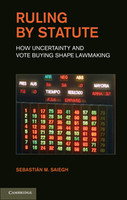
What are the main factors that allow presidents and prime ministers to enact policy through acts of government that carry the force of law? Or, simply put, when does a government actually govern? The theory presented in this book provides a major advance in our understanding of statutory policy making. Using a combination of an original analytical framework and statistical techniques, as well as historical and contemporary case studies, the book demonstrates that, contrary to conventional wisdom, variations in legislative passage rates are the consequences of differences in uncertainty, not partisan support. In particular, it shows that a chief executive's legislative success depends on the predictability of legislators' voting behavior and whether buying votes is a feasible option. From a normative standpoint, the book reveals that governability is best served when the opposition has realistic chances of occasionally defeating the executive in the legislative arena.
This is a reproduction of a book published before 1923. This book may have occasional imperfections such as missing or blurred pages, poor pictures, errant marks,...
This work has been selected by scholars as being culturally important, and is part of the knowledge base of civilization as we know it. This work was reproduced from the original artifact, and...
The Making of the Modern Law: Legal Treatises, 1800-1926 includes over 20,000 analytical, theoretical and practical works on American and British Law. It includes the writings of...
This is a reproduction of a book published before 1923. This book may have occasional imperfections such as missing or blurred pages, poor pictures,...