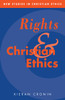
Kieran Cronin aims in this book to show how a Christian perspective may have something fruitful to contribute to the language of rights. In so doing, he examines some of the complexities involved in using this language, drawing from literature in moral philosophy and jurisprudence in the process. The novelty of his approach lies in the attempt to distinguish two complementary aspects within metaethics, aspects which the author calls the 'discursive' and the 'imaginative'. Cronin regards the use of models (which are extended metaphors) as providing a bridge between these two aspects, and the imaginative metaethics which emerges is seen to be rich in possibilities for both secular and Christian understandings of rights-talk.
In this seminal work of Christian ethics, Knight lays out a framework for understanding the moral teachings of Jesus. Drawing on a wide range of biblical and philosophical sources, he argues that...
This work has been selected by scholars as being culturally important, and is part of the knowledge base of civilization as we know it. This work was reproduced from the original artifact, and...
This work has been selected by scholars as being culturally important and is part of the knowledge base of civilization as we know it.This work is in the public domain in the United States of...
This is a reproduction of a book published before 1923. This book may have occasional imperfections such as missing or blurred pages, poor pictures,...