


Trending Bestseller
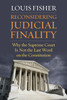
Reconsidering Judicial Finality
Why the Supreme Court Is Not the Last Word on the Constitution
Paperback / softback
01 July 2023
$75.00
Ships in 3-5 business days
Reconsidering Judicial Finality
$75.00
Description
Federal judges, legal scholars, pundits, and reporters frequently describe the Supreme Court as the final word on the meaning of the Constitution. The historical record presents an entirely different picture. A close and revealing reading of that record, from 1789 to the present day, Reconsidering Judicial Finality reminds us of the "unalterable fact," as Chief Justice Rehnquist once remarked, "that our judicial system, like the human beings who administer it, is fallible." And a Court inevitably prone to miscalculation and error, as this book clearly demonstrates, cannot have the incontrovertible last word on constitutional questions.
In this deeply researched, sharply reasoned work of legal myth-busting, constitutional scholar Louis Fisher explains how constitutional disputes are settled by all three branches of government, and by the general public, with the Supreme Court often playing a secondary role. The Court's decisions have, of course, been challenged and reversed in numerous cases--involving slavery, civil rights, child labor legislation, Japanese internment during World War II, abortion, and religious liberty. What Fisher shows us on a case-by-case basis is how the elected branches, scholars, and American public regularly press policies contrary to Court rulings--and regularly prevail, although the process might sometimes take decades. From the common misreading of Marbury v. Madison, to the mistaken understanding of the Supreme Court as the trusted guardian of individual rights, to the questionable assumptions of the Court's decision in Citizens United, Fisher's work charts the distance and the difference between the Court as the ultimate arbiter in constitutional matters and the judgment of history.
The verdict of Reconsidering Judicial Finality is clear: to treat the Supreme Court's nine justices as democracy's last hope or as dangerous activists undermining democracy is to vest them with undue significance. The Constitution belongs to all three branches of government--and, finally, to the American people.
You May Like

Jesus Reconsidered
Often referred to by the press and critics alike as a single voice, the Jesus Seminar is not, in fact, monolithic writes Bernard Brandon Scott. "Biblical scholars are notoriously independent and...
$41.00

Retribution Reconsidered
Jeffrie G. Murphy's second collection of essays further pursues the topics of punishment and retribution that were explored in his 1979 collection Retribution, Justice and Therapy. ...
$227.00
Customers Also Viewed
Buy Books Online at BookLoop
Discover your next great read at BookLoop, Australiand online bookstore offering a vast selection of titles across various genres and interests. Whether you're curious about what's trending or searching for graphic novels that captivate, thrilling crime and mystery fiction, or exhilarating action and adventure stories, our curated collections have something for every reader. Delve into imaginative fantasy worlds or explore the realms of science fiction that challenge the boundaries of reality. Fans of contemporary narratives will find compelling stories in our contemporary fiction section. Embark on epic journeys with our fantasy and science fiction titles,
Shop Trending Books and New Releases
Explore our new releases for the most recent additions in romance books, fantasy books, graphic novels, crime and mystery books, science fiction books as well as biographies, cookbooks, self help books, tarot cards, fortunetelling and much more. With titles covering current trends, booktok and bookstagram recommendations, and emerging authors, BookLoop remains your go-to local australian bookstore for buying books online across all book genres.
Shop Best Books By Collection
Stay updated with the literary world by browsing our trending books, featuring the latest bestsellers and critically acclaimed works. Explore titles from popular brands like Minecraft, Pokemon, Star Wars, Bluey, Lonely Planet, ABIA award winners, Peppa Pig, and our specialised collection of ADHD books. At BookLoop, we are committed to providing a diverse and enriching reading experience for all.