This new se ries is concerned with intercellular communication and recognition. It is now widely appreciated that these processes playa crucial role in virtually all biological systems and functions. These encompass fertilisation, embryonic development, infectious interactions, the activity of the nervous system, the regulation of growth and develop ment by hormones and the immune response to foreign or 'non-self antigens. Historically as described in the first review in this volume, the general concept of cell-associated receptors as the molecular entity primarily responsible for the specificity of signal recognition arose independently in the fields of immunology, pharmacology and developmental biology. From an early stage the analogy between cellular recognition and the discriminatory activity of antibodies and enzymes was emphasised. A vital conceptual advance, expressed most c1early by Linus Pauling and Paul Weiss, was the idea that non-covalent molecular interactions (of proteins in particular) were responsible forbiological specificity in in general. In the last decade several major advances have led to a new level of understanding of the molecular basis of cellular recognition. In several systems (in particular with neurotransmitters, hormones and antigens) it is possible to direct1y demonstrate the existence of receptors - associated in each case with the cell surface. These studies have been paralleled by equally important insights into the general structure and organisation of cell membranes and the possible ways in which signals arriving from the 'outside' can be transduced across the cell surface membrane to induce or regulate the cell's programmed responses.
This new se ries is concerned with intercellular communication and recognition. It is now widely appreciated that these processes playa crucial role in virtually all biological systems and functions. These encompass fertilisation, embryonic development, infectious interactions, the activity of the nervous system, the regulation of growth and develop ment by hormones and the immune response to foreign or 'non-self antigens. Historically as described in the first review in this volume, the general concept of cell-associated receptors as the molecular entity primarily responsible for the specificity of signal recognition arose independently in the fields of immunology, pharmacology and developmental biology. From an early stage the analogy between cellular recognition and the discriminatory activity of antibodies and enzymes was emphasised. A vital conceptual advance, expressed most c1early by Linus Pauling and Paul Weiss, was the idea that non-covalent molecular interactions (of proteins in particular) were responsible forbiological specificity in in general. In the last decade several major advances have led to a new level of understanding of the molecular basis of cellular recognition. In several systems (in particular with neurotransmitters, hormones and antigens) it is possible to direct1y demonstrate the existence of receptors - associated in each case with the cell surface. These studies have been paralleled by equally important insights into the general structure and organisation of cell membranes and the possible ways in which signals arriving from the 'outside' can be transduced across the cell surface membrane to induce or regulate the cell's programmed responses.
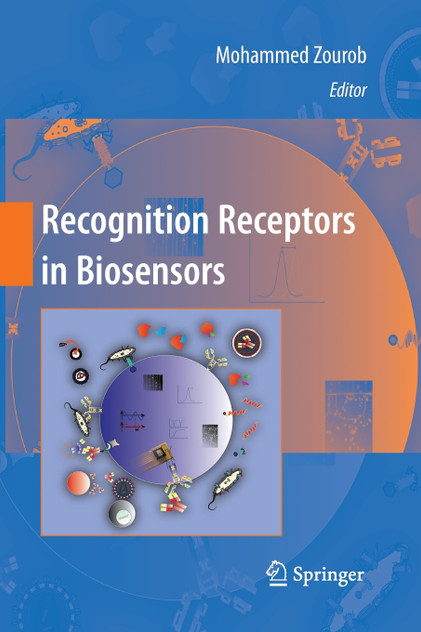
Recognition receptors play a key role in the successful implementation of chemical and biosensors. Molecular recognition refers to non-covalent speci?c binding between molecules, one of which is...
This book offers comprehensive information on the polymorphisms of genes encoding pattern recognition receptors (PRRs). Following a short description of the general role of PRRs in the immune system,...
Receptors: Models for Binding, Trafficking, and Signaling bridges the gap between chemical engineering and cell biology by lucidly and practically demonstrating how a mathematical modeling approach...
Recognitions is about the most neglected strand of Aristotelian poetics - anagnorisis, or recognition. It is a topic that has conventionally had a bad press: the recognition scene is regarded as an...
Discover your next great read at BookLoop, Australiand online bookstore offering a vast selection of titles across various genres and interests. Whether you're curious about what's trending or searching for graphic novels that captivate, thrilling crime and mystery fiction, or exhilarating action and adventure stories, our curated collections have something for every reader. Delve into imaginative fantasy worlds or explore the realms of science fiction that challenge the boundaries of reality. Fans of contemporary narratives will find compelling stories in our contemporary fiction section. Embark on epic journeys with our fantasy and science fiction titles,
Shop Trending Books and New Releases
Explore our new releases for the most recent additions in romance books, fantasy books, graphic novels, crime and mystery books, science fiction books as well as biographies, cookbooks, self help books, tarot cards, fortunetelling and much more. With titles covering current trends, booktok and bookstagram recommendations, and emerging authors, BookLoop remains your go-to local australian bookstore for buying books online across all book genres.
Shop Best Books By Collection
Stay updated with the literary world by browsing our trending books, featuring the latest bestsellers and critically acclaimed works. Explore titles from popular brands like Minecraft, Pokemon, Star Wars, Bluey, Lonely Planet, ABIA award winners, Peppa Pig, and our specialised collection of ADHD books. At BookLoop, we are committed to providing a diverse and enriching reading experience for all.
Sign In
your cart
Your cart is empty
Menu
Search
PRE-SALES
If you have any questions before making a purchase chat with our online operators to get more information.