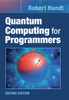
This introduction to quantum computing from a classical programmer's perspective is meant for students and practitioners alike. Over 25 fundamental algorithms are explained with full mathematical derivations and classical code for simulation, using an open-source code base developed from the ground up in Python and C++. After presenting the basics of quantum computing, the author focuses on algorithms and the infrastructure to simulate them efficiently, beginning with quantum teleportation, superdense coding, and Deutsch-Jozsa. Coverage of advanced algorithms includes the quantum supremacy experiment, quantum Fourier transform, phase estimation, Shor's algorithm, Grover's algorithm with derivatives, quantum random walks, and the Solovay-Kitaev algorithm for gate approximation. Quantum simulation is explored with the variational quantum eigensolver, quantum approximate optimization, and the Max-Cut and Subset-Sum algorithms. The book also discusses issues around programmer productivity, quantum noise, error correction, and challenges for quantum programming languages, compilers, and tools, with a final section on compiler techniques for transpilation.
This introduction to quantum computing from a classical programmer's perspective is meant for students and practitioners alike. More than 50 quantum techniques and algorithms are explained with...
Recently (2020,06), according to the Financial Times, Google researcher Stephen Foley claimed "Big moment! Google claims to have researced quantum supremacy, taking 3 mins to do a calculation...
The book covers elementary concepts, from how to produce simple graphical objects using logical coordinates to producing filled regions. The book reinforces concepts with useful and simple examples,...
? Colin P. Williams Jet Propulsion Laboratory, California Institute of Technology, 4800 Oak Grove Drive, Pasadena, CA 91109-8099, email: Colin. P. Williams@jpl. nasa. gov Over the past half century...