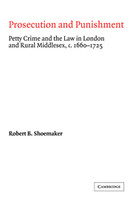
The law was one of the most potent sources of authority and stability in early modern England. Historians, however, have argued over whether the discretion and flexibility embodied in the judicial system was used as a method of social control, and by focusing their attention on felonies and on the action of the protagonists in judicial decisions they have tended to ignore rich sources of information concerning attitudes towards and experiences of the law. Misdemeanour prosecutions affected many more people (and a broader social variety of participants) than felony prosecutions, and in their choice of methods of prosecution both victims and Justices of the Peace exercised considerably greater flexibility in responding to petty crimes than they did with felonies. This book examines the day-to-day operation of the criminal justice system in Middlesex from the point of view of plaintiffs and defendants, and offers an assessment of the social significance of the law in pre-industrial England.
The Making of the Modern Law: Legal Treatises, 1800-1926 includes over 20,000 analytical, theoretical and practical works on American and British Law. It includes the writings of...
This pioneering work collects an amazing assemblage of court cases in which animals have been named as defendants--chickens, rats, field mice, bees, gnats, and (in 34 recorded instances) pigs, among...
An innocent man has been in prison since 1990. He was framed for murdering prison director, Michael Francke, by organized crime figures in the top echelons of Oregon's government. This book exposes...
In this book, lawyer and jurist Alfred Bettman details the intricacies of the prosecution process in the American legal system. He provides readers with an in-depth analysis of the roles and...