Trending Bestseller

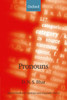
Pronouns

No reviews yet Write a Review
This study of pronouns is based on more than 250 languages. It contrasts personal pronouns with pronouns such as demonstratives, interrogatives, and relatives and shows that they belong to two distinct categories. Characteristics of the two categories are introduced and examined from a cross-linguistic and functional perspective.
Paperback / softback
01-November-2007
RRP: $141.95
$120.00
Ships in 3-5 business days
Hurry up! Current stock:
On the basis of a cross-linguistic study of more than 250 languages, this book brings to light several fascinating characteristics of pronouns. Dr Bhat argues that these words do not form a single category, but rather two different categories called 'personal pronouns' and 'proforms'. He points out several differences between the two, such as the occurrence of a dual structure among proforms but not among personal pronouns. These differences are shown to derive from the distinct functions that the two categories have to perform in language. The book also shows that the so-called interrogative pronouns of familiar languages are less concerned with interrogation than with indefiniteness. The author shows that the notion of indefiniteness that can be associated with these and other pronouns is quite different from the one that can be associated with noun phrases. He goes on to postulate certain typological distinctions such as 'two-person' and 'three-person' languages and 'free-pronoun' and 'bound-pronoun' languages.

This product hasn't received any reviews yet. Be the first to review this product!

RRP: $141.95
$120.00
Ships in 3-5 business days
Hurry up! Current stock:

Pronouns

RRP: $141.95
$120.00

Description

On the basis of a cross-linguistic study of more than 250 languages, this book brings to light several fascinating characteristics of pronouns. Dr Bhat argues that these words do not form a single category, but rather two different categories called 'personal pronouns' and 'proforms'. He points out several differences between the two, such as the occurrence of a dual structure among proforms but not among personal pronouns. These differences are shown to derive from the distinct functions that the two categories have to perform in language. The book also shows that the so-called interrogative pronouns of familiar languages are less concerned with interrogation than with indefiniteness. The author shows that the notion of indefiniteness that can be associated with these and other pronouns is quite different from the one that can be associated with noun phrases. He goes on to postulate certain typological distinctions such as 'two-person' and 'three-person' languages and 'free-pronoun' and 'bound-pronoun' languages.

Customers Also Viewed