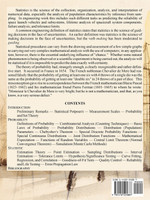
Statistics is the science of the collection, organization, analysis, and interpretation of numerical data, especially the analysis of population characteristics by inference from sampling. In engineering work this includes such different tasks as predicting the reliability of space launch vehicles and subsystems, lifetime analysis of spacecraft system components, failure analysis, and tolerance limits.A common engineering definition of statistics states that statistics is the science of guiding decisions in the face of uncertainties. An earlier definition was statistics is the science of making decisions in the face of uncertainties, but the verb making has been moderated to guiding.Statistical procedures can vary from the drawing and assessment of a few simple graphs to carrying out very complex mathematical analysis with the use of computers; in any application, however, there is the essential underlying influence of "chance." Whether some natural phenomenon is being observed or a scientific experiment is being carried out, the analysis will be statistical if it is impossible to predict the data exactly with certainty.The theory of probability had, strangely enough, a clearly recognizable and rather definitive start. It occurred in France in 1654. The French nobleman Chevalier de Mere had reasoned falsely that the probability of getting at least one six with 4 throws of a single die was the same as the probability of getting at least one "double six" in 24 throws of a pair of dice. This misconception gave rise to a correspondence between the French mathematician Blaise Pascal (1623-1662) and his mathematician friend Pierre Fermat (1601-1665) to whom he wrote: "Monsieur le Chevalier de Mere is very bright, but he is not a mathematician, and that, as you know, is a very serious defect."CONTENTS: Introduction - Preliminary Remarks - Statistical Potpourri - Measurement Scales - Probability and Set TheoryProbabilityDefinitions of Probability - Combinatorial Analysis (Counting Techniques) - Basic Laws of Probability - Probability Distributions - Distribution (Population) Parameters - Chebyshev's Theorem - Special Discrete Probability Functions - Special Continuous Distributions - Joint Distribution Functions - Mathematical Expectation - Functions of Random Variables - Central Limit Theorem (Normal Convergence Theorem) - Simulation (Monte Carlo Methods)StatisticEstimation Theory - Point Estimation - Sampling Distributions - Interval Estimation - Tolerance Limits - Hypothesis/Significance Testing - Curve Fitting, Regression, and Correlation - Goodness-of-Fit Tests - Quality Control - Reliability and Life Testing - Error Propagation LawBibliography
Probability and Statistics in Aerospace Engineering
RRP:
$35.00
Description
Statistics is the science of the collection, organization, analysis, and interpretation of numerical data, especially the analysis of population characteristics by inference from sampling. In engineering work this includes such different tasks as predicting the reliability of space launch vehicles and subsystems, lifetime analysis of spacecraft system components, failure analysis, and tolerance limits.A common engineering definition of statistics states that statistics is the science of guiding decisions in the face of uncertainties. An earlier definition was statistics is the science of making decisions in the face of uncertainties, but the verb making has been moderated to guiding.Statistical procedures can vary from the drawing and assessment of a few simple graphs to carrying out very complex mathematical analysis with the use of computers; in any application, however, there is the essential underlying influence of "chance." Whether some natural phenomenon is being observed or a scientific experiment is being carried out, the analysis will be statistical if it is impossible to predict the data exactly with certainty.The theory of probability had, strangely enough, a clearly recognizable and rather definitive start. It occurred in France in 1654. The French nobleman Chevalier de Mere had reasoned falsely that the probability of getting at least one six with 4 throws of a single die was the same as the probability of getting at least one "double six" in 24 throws of a pair of dice. This misconception gave rise to a correspondence between the French mathematician Blaise Pascal (1623-1662) and his mathematician friend Pierre Fermat (1601-1665) to whom he wrote: "Monsieur le Chevalier de Mere is very bright, but he is not a mathematician, and that, as you know, is a very serious defect."CONTENTS: Introduction - Preliminary Remarks - Statistical Potpourri - Measurement Scales - Probability and Set TheoryProbabilityDefinitions of Probability - Combinatorial Analysis (Counting Techniques) - Basic Laws of Probability - Probability Distributions - Distribution (Population) Parameters - Chebyshev's Theorem - Special Discrete Probability Functions - Special Continuous Distributions - Joint Distribution Functions - Mathematical Expectation - Functions of Random Variables - Central Limit Theorem (Normal Convergence Theorem) - Simulation (Monte Carlo Methods)StatisticEstimation Theory - Point Estimation - Sampling Distributions - Interval Estimation - Tolerance Limits - Hypothesis/Significance Testing - Curve Fitting, Regression, and Correlation - Goodness-of-Fit Tests - Quality Control - Reliability and Life Testing - Error Propagation LawBibliography
The theory of probability and mathematical statistics is becoming an indispensable discipline in many branches of science and engineering. This is caused by increasing significance of various...
This textbook differs from others in the field in that it has been prepared very much with students and their needs in mind, having been classroom tested over many years. It is a true...
Discover your next great read at BookLoop, Australiand online bookstore offering a vast selection of titles across various genres and interests. Whether you're curious about what's trending or searching for graphic novels that captivate, thrilling crime and mystery fiction, or exhilarating action and adventure stories, our curated collections have something for every reader. Delve into imaginative fantasy worlds or explore the realms of science fiction that challenge the boundaries of reality. Fans of contemporary narratives will find compelling stories in our contemporary fiction section. Embark on epic journeys with our fantasy and science fiction titles,
Shop Trending Books and New Releases
Explore our new releases for the most recent additions in romance books, fantasy books, graphic novels, crime and mystery books, science fiction books as well as biographies, cookbooks, self help books, tarot cards, fortunetelling and much more. With titles covering current trends, booktok and bookstagram recommendations, and emerging authors, BookLoop remains your go-to local australian bookstore for buying books online across all book genres.
Shop Best Books By Collection
Stay updated with the literary world by browsing our trending books, featuring the latest bestsellers and critically acclaimed works. Explore titles from popular brands like Minecraft, Pokemon, Star Wars, Bluey, Lonely Planet, ABIA award winners, Peppa Pig, and our specialised collection of ADHD books. At BookLoop, we are committed to providing a diverse and enriching reading experience for all.
Sign In
your cart
Your cart is empty
Menu
Search
PRE-SALES
If you have any questions before making a purchase chat with our online operators to get more information.